In this article
Start with the campground, not a general park search
Open the NPS campground list, choose a campground, and follow its Recreation.gov booking link. Check its actual operating season before calculating a release day. This guide checks the official US pages on October 10, 2026; seasonal opening dates can change.
A Yosemite search can include places outside the national park. Read the location, equipment rules and travel distance rather than assuming every result is a Yosemite Valley campsite. Keep a short planning note: campground, first night, last night, tent or RV, and acceptable alternatives.
NPS's booking walkthrough explains how to filter by camping, group size and equipment. For a trailer, check the individual site's length limit; the guide warns that the search filter may not give the right trailer result. A campsite being available does not make it suitable for your vehicle.
Which reservation window applies?
The official reservation page separates four windows. Its non-lottery releases occur at 7 am Pacific time. This is a scheduled release, not a guarantee that a site will remain available while you finish searching.
| Campground or inventory | Published advance window |
|---|---|
| Upper Pines, Lower Pines, North Pines, Wawona and Hodgdon Meadow | Five-month batches on the 15th |
| Half of Tuolumne Meadows sites | Two-month batches on the 15th |
| Bridalveil Creek, Crane Flat, Tamarack Flat, White Wolf, Yosemite Creek and Porcupine Flat | Rolling fourteen days |
| Other half of Tuolumne Meadows sites | Rolling fourteen days |
| Camp 4 | Rolling seven days |
Use the current campground listing to establish whether the campground is open. An advance window is not an opening forecast. The general page still includes a dated 2025 Camp 4 seasonal sentence; do not carry that date into a 2027 plan.
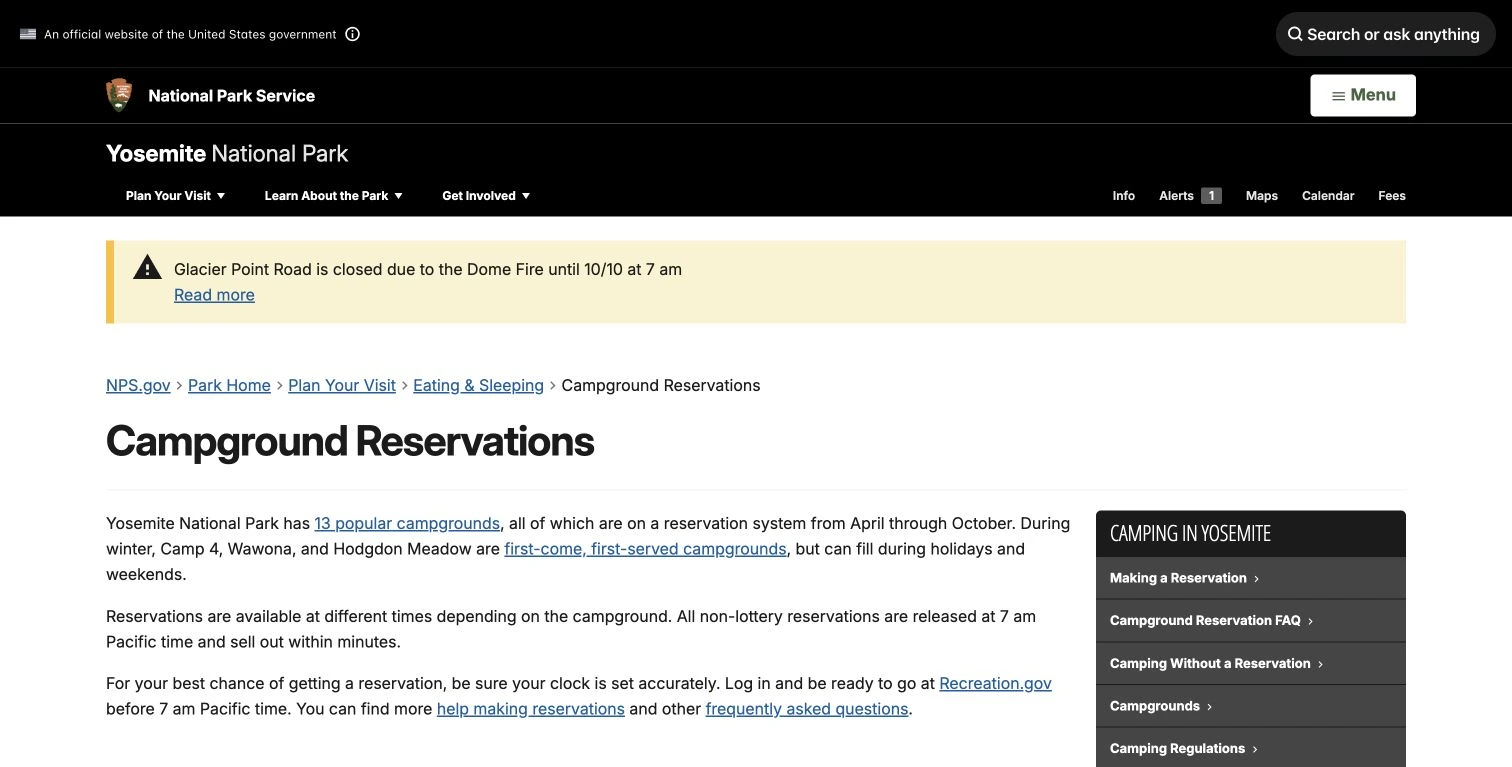
Source: National Park Service, Yosemite campground reservations, captured October 10, 2026. The page states that release windows vary by campground. Read the table above as a planning summary and recheck the source before booking.
Calculate a release day from the arrival window
For the five-month batch, an arrival from July 15 through August 14 maps to March 15. A different first night can put you in another batch, even if most of your trip is in the same month.
Here is a worked planning example under the currently published rule:
- First night: July 20, 2027 at a campground using the five-month batch.
- Relevant arrival band: July 15–August 14.
- Planning release: March 15, 2027 at 7 am Pacific, subject to the campground's published season and any revised policy.
- A fourteen-day campground for the same first night instead points to July 6, 2027; a seven-day window points to July 13.
These are calculations from the present rule, not confirmed 2027 operating announcements. Add the release to your calendar using the America/Los_Angeles time zone so daylight-saving changes are handled correctly. Avoid copying a fixed “PST” conversion into every month.
Separate your release reminder from a change alert. A reminder tells you a scheduled time has arrived. An alert tells you a page now displays a condition you asked to watch. Neither guarantees a booking.
If the calendar is full, use the built-in alert first
On the campground availability calendar, look for the bell icon. NPS's reservation-help page recommends it for a specific campground and date. Recreation.gov's reservation tips explain its availability-alert option.
Choose the campground and dates you can actually use. When an alert arrives, return to the booking page and verify the site before proceeding. A notification does not reserve inventory for you, and another visitor may book it first.
If a full stay has no matches, NPS suggests searching one night at a time. Decide beforehand whether moving between campsites is acceptable. Finding separate nights creates a different trip from keeping one campsite throughout; account for packing, checkout and travel between sites.
Our Yellowstone camping reservation guide illustrates why each park needs its own booking rules. Do not transfer a release window from Yellowstone or a state park to Yosemite.
“No entrance reservation” does not mean free camping
NPS states that a reservation is not required to enter Yosemite in 2026. That statement concerns entrance reservations. It does not supply a campsite, remove the entrance fee, or announce the entrance policy for 2027.
CBS47 KSEE24's February 20, 2026 report below demonstrates the distinction that often gets lost in a headline. It covers vehicle entry in 2026; use the campground pages for overnight reservations.
If your trip depends on staying overnight inside the park, confirm the camping reservation separately. Do not treat a parking space or roadside pullout as a camping alternative: the NPS help page limits sleeping in a vehicle to campsites.
Use PageDog for a changed announcement, not an unseen booking form
The native calendar alert is the simplest option for a cancelled campsite. PageDog has a different useful job: watching an official seasonal announcement you are waiting for, such as a specific campground's reopening or a newly announced reservation season.
Open the public NPS campground page on your Mac, select the visible announcement area, and describe one condition: “Notify me when this notice explicitly announces the 2027 opening date for Tuolumne Meadows.” Keep the name and year in the condition so a road update or another campground does not satisfy it.
PageDog reloads the page and checks the selected visible area locally on your Mac, with hosted AI evaluating the captured condition. Your Mac must stay awake and connected. It does not reserve a campsite, bypass CAPTCHA, or guarantee that calendar filters chosen in an interactive form survive a fresh page load.
Use the PageDog setup guide for the watch, and our guide to reducing false change alerts to make the condition precise. When an announcement appears, read the source, update your release reminder, and complete booking yourself through Recreation.gov.