In this article
Key facts
| Question | Current answer | Important caveat |
|---|---|---|
| How much is Notion Plus? | $10/member/month annually; $12 monthly | Every workspace member consumes a paid seat. |
| How much is Notion Business? | $20/member/month annually; $24 monthly | Custom Agents still require separately purchased credits. |
| Is Notion free? | Yes | Free has a 10-guest limit, 5 MB uploads, 7-day history, and limited blocks for teams of 2+. |
| Are guests billable? | No | Guests are page-level collaborators; members are workspace-wide paid seats. |
| Is Notion AI included? | Business includes core Notion Agent, Meeting Notes, and Enterprise Search features | Free and Plus show limited trials; Custom Agents use credits. |
| What do Custom Agents cost? | $10 per 1,000 monthly Notion credits | Usage varies by task and unused monthly credits do not roll over. |
These public US list prices and rules were checked on September 8, 2026. Taxes, regional pricing, mobile-store subscriptions, sales-led terms, and promotions can change the invoice.
Notion plans and prices at a glance
Notion's official pricing page divides the product into an organizational layer and an AI-workspace layer.
| Plan | Annual-billing rate | Month-to-month rate | Best fit |
|---|---|---|---|
| Free | $0 | $0 | An individual or very small trial workspace. |
| Plus | $10/member/mo | $12/member/mo | Small teams needing unlimited blocks, uploads, charts, forms, and basic connections. |
| Business | $20/member/mo | $24/member/mo | Growing teams needing Notion Agent, AI Meeting Notes, Enterprise Search, SAML SSO, and granular permissions. |
| Enterprise | Custom | Custom | Organizations needing SCIM, audit logs, advanced security, managed domains, and support. |
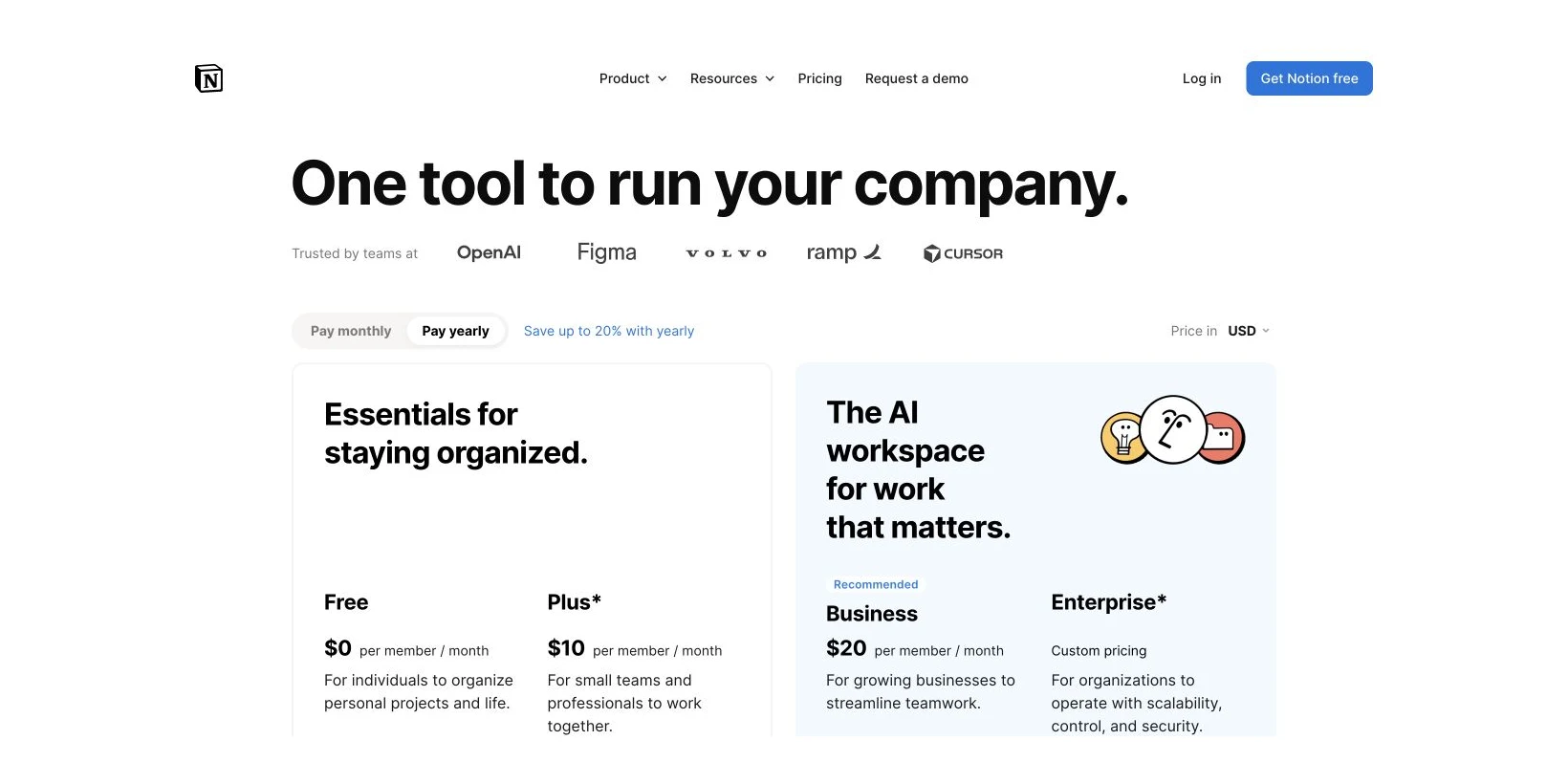
Screenshot: the official Notion pricing page with annual billing and USD selected. Captured from the live branded page on 2026-09-08 at native resolution, padded without resampling, and encoded as a 1,640-pixel WebP for crisp article rendering.
Annual billing saves $24 per Plus member and $48 per Business member over twelve months. Monthly billing is still useful while headcount or the required plan is unsettled; the discount matters only after the seat count is stable.
What 1, 5, 10, or 25 members cost
These totals use annual billing and assume every listed person is a workspace member rather than a guest.
| Paid members | Plus monthly equivalent | Plus annual total | Business monthly equivalent | Business annual total |
|---|---|---|---|---|
| 1 | $10 | $120 | $20 | $240 |
| 5 | $50 | $600 | $100 | $1,200 |
| 10 | $100 | $1,200 | $200 | $2,400 |
| 25 | $250 | $3,000 | $500 | $6,000 |
For ten members, choosing month-to-month billing for a full year costs $1,440 on Plus or $2,880 on Business—$240 or $480 more than annual billing. Custom Agent credits, paid site domains, tax, and enterprise terms sit outside these totals.
Members, guests, and the billing trap
Notion's member billing guide says one seat is assigned to each workspace member. Adding a member to a paid workspace is billable. Guests are invited to specific pages, have narrower access, and do not consume a paid seat while the plan's guest allowance remains available.
That distinction is the biggest avoidable source of surprise:
- Use a member for someone who needs workspace-wide access, teamspaces, or broad collaboration.
- Use a guest for a client, contractor, or partner who needs only selected pages.
- Confirm the role before inviting. Notion explicitly offers a “Skip for now” step to keep an invitee a guest instead of upgrading them to a member.
Added members are prorated for their time in the billing interval. Removing a member does not produce a mid-cycle prorated refund; the lower count takes effect at the next billing cycle. Until then, the open paid seat can be reassigned.
What each paid plan actually unlocks
Plus removes the main collaboration constraints: unlimited collaborative blocks, unlimited file uploads, unlimited charts, custom forms and sites, basic connections, 30-day page history, and unlimited external guests. It still shows only a trial of Notion AI.
Business adds the current AI workspace: Notion Agent, AI Meeting Notes, and Enterprise Search, alongside SAML SSO, granular database permissions, page verification, private teamspaces, domain verification, premium connections, and 90-day history.
Enterprise is primarily a governance decision. Its public comparison adds SCIM provisioning, audit logs, advanced security controls, managed domains, organization controls, custom data retention, zero data retention with LLM providers, a customer success manager, and unlimited history. Price requires a quote.
Notion-certified consultant Lou Attal's March 2026 walkthrough compares the four plans and seat-based billing. It is helpful orientation; Notion's live page remains authoritative for prices and the newer Custom Agent credit rules.
Notion AI is no longer one simple add-on
The base plan comparison now separates core AI workspace features from background Custom Agents. Free and Plus include limited trials. Business includes Notion Agent, Meeting Notes, and Enterprise Search, while Enterprise adds governance and zero-retention controls.
Custom Agents are different. Notion's official credit guide says every run draws from a workspace-wide credit balance. Reading more content, taking more steps, running more often, and selecting more advanced models can increase consumption.
Notion publishes these current orientation ranges:
| Example Custom Agent | Approximate cost per run |
|---|---|
| Q&A | $0.03–$0.11 |
| Task routing | $0.05–$0.15 |
| Status update | $0.08–$0.18 |
| Mail triage | $0.04–$0.10 |
| Daily brief | $0.10–$0.30 |
Those are estimates, not caps. The agent's actual dashboard is the best forecast after one or two billing cycles. Monthly credits cost $10 per 1,000, are shared across the workspace, reset monthly, and do not roll over. Notion notifies admins at 80% and 100%; agents pause if the balance is exhausted.
Plus vs Business: the practical break point
Choose Plus if the team mainly needs documents, databases, uploads, forms, sites, charts, and guest collaboration. It is half the annual per-seat price of Business, so a ten-member team saves $1,200 a year before AI credits.
Choose Business when at least one Business-only capability is operationally required: full core Notion AI, Meeting Notes, Enterprise Search, SAML SSO, granular database permissions, private teamspaces, or domain verification. Do not upgrade solely because a limited AI trial ended if the team would not use the broader Business controls.
Choose Enterprise when procurement, identity lifecycle, auditability, advanced retention, or organization-wide controls determine the purchase. Its value cannot be judged from a public per-seat calculation because the contract is custom.
The independent Digital Project Manager pricing review is useful for comparing buyer profiles, but older reviews may still describe Notion AI as a single flat inclusion. Verify the current credit layer before budgeting.
How to catch a Notion pricing change
Use Notion's workspace billing screens for private invoices, member counts, and credits. For a public change, PageDog can monitor one visible region on the pricing or Help Center page—such as the Plus price, the member-removal rule, or the $10 credit line—and notify you when that exact evidence changes. It cannot see a private contract, count hidden seats, or manage a subscription.
For adjacent comparisons, see Airtable pricing, Asana pricing, the SaaS pricing changes guide, and the website price-tracker guide.
Frequently asked questions
Is Notion $10 per workspace or per person?
Per member. Plus is $10 per member per month on annual billing, not $10 for the whole workspace. Guests invited only to specific pages are not paid seats.
Is Notion Plus $10 or $12 a month?
$10 is the monthly equivalent when billed annually; $12 is month-to-month. Business uses the same pattern: $20 annually or $24 month-to-month.
Does Notion Business include unlimited AI?
Business includes the listed core Notion AI workspace features, but Custom Agents use separately purchased credits. Their cost depends on what each run reads, does, and which model it uses.
What happens when a member is removed?
The seat remains available until the end of the current billing interval and can be reassigned. The lower billed seat count takes effect at the next cycle; removals are not prorated mid-cycle.
Bottom line
For most small teams, Notion Plus is the economical default at $10 per member monthly on annual billing. Business doubles the base seat price and is justified by AI workspace features, SSO, search, and permissions. Count members carefully, use guests honestly, and budget Custom Agent credits as a separate variable line.
Research sources
- Notion pricing — current USD annual and monthly prices, plan features, guest limits, history, and Custom Agent credit line; checked 2026-09-08.
- How members impact billing — seats, guests, proration, removals, and reassignment; checked 2026-09-08.
- Notion billing — upfront billing, workspaces, plan intervals, and billing changes; checked 2026-09-08.
- Notion credits and pricing for Custom Agents — shared credits, usage drivers, run-cost examples, notifications, and exhausted-credit behavior; checked 2026-09-08.
- Notion Custom Agents — $10 per 1,000 monthly credits, Business/Enterprise eligibility, monthly reset, and no rollover; checked 2026-09-08.