In this article
Key facts
| Question | Current answer | Important caveat |
|---|---|---|
| Is Asana free? | Personal is $0 for up to two people | A paid plan starts at two seats. |
| How much is Starter? | $10.99/user/month annually; $13.49 monthly | Above five users, seats are sold in blocks. |
| How much is Advanced? | $24.99/user/month annually; $30.49 monthly | It costs more than twice Starter and is mainly justified by portfolio-level work. |
| Are guests free? | External organization guests are free | In an Asana workspace, everyone can count toward the paid plan. |
| Are AI credits per user? | No | Starter's 50,000 and Advanced's 75,000 AI Studio Basic credits are per billing account each month. |
These are public US list prices and rules checked on September 2, 2026. Taxes, currencies, nonprofit discounts, add-ons, custom contracts, and future changes can produce a different invoice.
Asana plans and prices at a glance
Asana's current pricing page lists Personal, Starter, Advanced, Enterprise, and Enterprise+. Only Starter and Advanced have public per-user prices; the enterprise tiers require a quote.
| Plan | Annual-billing rate | Month-to-month rate | Best reason to choose it |
|---|---|---|---|
| Personal | $0 | $0 | One or two people need tasks, projects, boards, and calendars. |
| Starter | $10.99/user/month | $13.49/user/month | A team needs Timeline/Gantt, forms, custom fields, reporting, and automations. |
| Advanced | $24.99/user/month | $30.49/user/month | Multiple projects need portfolios, goals, workload, approvals, or native time tracking. |
| Enterprise / Enterprise+ | Custom | Custom | IT, security, governance, or compliance drives the purchase. |
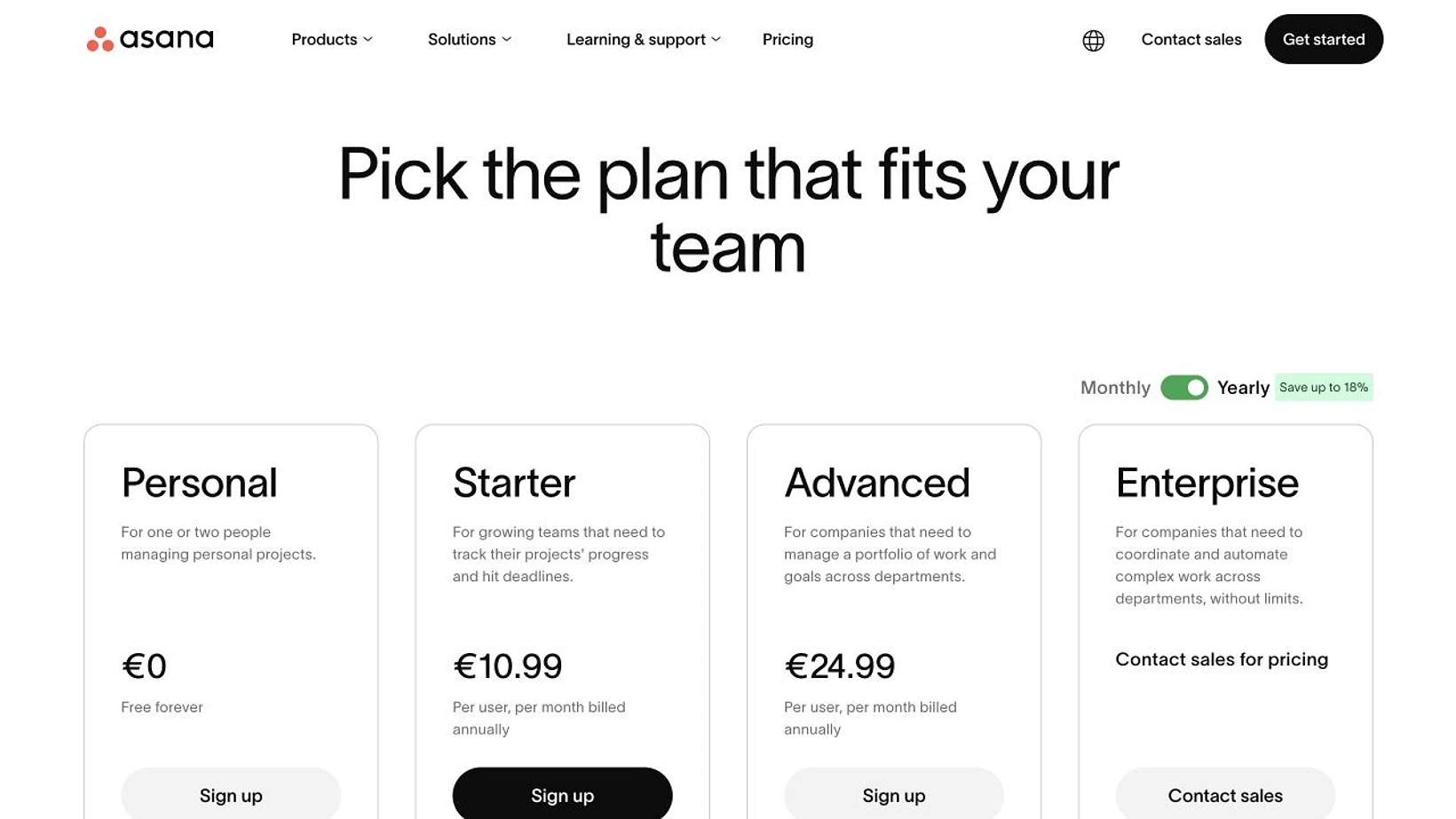
Screenshot: the official Asana pricing page shows the current plan structure and annual-billing prices. Captured 2026-09-02 in Portugal, so the visible cards are localized to euros. US-dollar figures in this guide were verified against Asana's current US pricing text. The 1,280-pixel browser capture was resized and conventionally sharpened to 1,640 pixels without changing its content.
Starter is the practical default for most small teams. Advanced is not a generic quality upgrade: its extra $14 per user per month on annual billing buys a specific layer of cross-project management.
What a 5-, 10-, or 25-person team actually pays
These totals assume every person needs a paid seat and the selected headcount is an available seat-block size.
| Team size | Starter, billed annually | Starter, billed monthly for 12 months | Advanced, billed annually | Advanced, billed monthly for 12 months |
|---|---|---|---|---|
| 5 | $659.40 | $809.40 | $1,499.40 | $1,829.40 |
| 10 | $1,318.80 | $1,618.80 | $2,998.80 | $3,658.80 |
| 25 | $3,297.00 | $4,047.00 | $7,497.00 | $9,147.00 |
Annual billing saves $30 per Starter seat or $66 per Advanced seat over 12 months. For ten Advanced seats, that is a $660 difference—but the annual commitment is less flexible.
The hidden variable: Asana sells seat blocks
The Asana subscription guide says paid plans start at two seats. Teams of two through five can add seats one at a time. After that, subscription sizes move in blocks:
| Active people | Seat increment | Example |
|---|---|---|
| 2–5 | 1 | Five people buy five seats. |
| 6–30 | 5 | Seven people buy ten seats. |
| 31–100 | 10 | Thirty-one people buy forty seats. |
| 101–500 | 25 | One hundred and one people buy 125 seats. |
| More than 500 | 50 | The next purchasable size rises by 50. |
That makes headcount timing material. Seven active people on annual Starter do not cost 7 × $10.99 × 12 ($923.16). They need ten seats, so the list-price total is $1,318.80—$395.64 more than a purely per-active-user calculation.
Asana's “no user seat limits” language means Starter and Advanced do not impose a maximum team size. It does not mean extra paid members are free.
MinorCo's December 19, 2025 walkthrough is useful because it explains workspaces versus organizations and connects each plan to real workflows. MinorCo is an Asana Solutions Partner, so treat it as informed partner context—not independent pricing authority—and verify current prices and seat rules on Asana's pages.
Who counts as a paid Asana member?
Where the subscription sits matters as much as who can open a task.
- On an organization plan, members who share the company's email domain count toward billing. External guests do not consume paid seats.
- On a team plan inside an organization, people on that paid team need licenses unless they already have one elsewhere in the subscription. External guests remain free.
- In a workspace, there is no same-domain guest distinction: everyone collaborating in the workspace can count toward the paid plan.
- In a division, one person in several covered teams counts once, but every covered member still needs a license.
The safest estimate starts with the actual Asana space being upgraded, then separates internal members from true external guests. A generic “we have 25 collaborators” count is not enough.
When Advanced is worth more than twice Starter
Choose Advanced when at least one of its gated workflows is already necessary:
| Requirement | Starter | Advanced |
|---|---|---|
| Timeline and Gantt | Included | Included |
| Forms, custom fields, reporting, automations | Included | Included |
| Portfolios and company/team goals | Not included | Included |
| Workload across projects in a portfolio | Not included | Included |
| Approvals and proofing | Not included | Included |
| Native time tracking and formulas | Not included | Included |
| AI Studio Basic monthly account credits | 50,000 | 75,000 |
For a ten-person team, moving from annual Starter to annual Advanced adds $1,680 a year. If portfolios, workload, or approvals do not replace an existing process or recurring manual work, Starter is usually the better starting point.
Also budget separately for add-ons. The live pricing page currently lists Timesheets & Budgets at $5.99 per user per month billed annually. On ten seats, that is another $718.80 a year.
How to catch an Asana pricing change
Use Asana's billing console for your private seat count and invoice. For public changes, PageDog can watch one stable visible region—such as the Starter price, the seat-increment FAQ, or the Timesheets & Budgets line—and alert you when that evidence changes. Keep one condition per monitor and review the visible before-and-after result; a public-page monitor cannot see taxes, private discounts, or your contract. See the SaaS pricing changes guide, the guide to reducing false website-change alerts, or PageDog documentation.
The practical Asana pricing rule
- Pick the lowest tier that contains a workflow you already need.
- Identify the organization, team, division, or workspace being upgraded.
- Count billable internal members and remove only valid external guests.
- Round the headcount to Asana's next purchasable seat block.
- Add per-seat add-ons, tax, and the cost of monthly-versus-annual flexibility.
For five, ten, or 25 paid people, the public rate multiplies cleanly. Between those block sizes, the invoice can rise before the team actually fills the seats.
Research sources
- Asana pricing — current public plan prices, features, AI Studio Basic credits, and add-on pricing.
- Asana subscriptions and pricing — seat increments, subscription spaces, members, and guest billing.
- Pricing and purchases — two-seat minimum and upgrade mechanics.
- CompareEdge's August 2026 Asana price check — independent verification of current public rates and the seat-block effect.
- MinorCo's embedded December 2025 plan walkthrough — partner context for choosing a tier.