
In this article
Open the official table before comparing numbers
Start with the State Department’s Global Visa Wait Times. On September 19, 2026, the page displayed Last updated: 17-SEP-2026 and described a monthly update cycle. That date belongs with any number copied from the table.
Find your city or consular post, then read the heading above the relevant visa-category column. B1/B2, F/M/J and petition-based categories have separate fields. A figure from another category is not a substitute for the one you need, even when the city name matches.
The simplest way to follow the public report is to bookmark it and set a monthly reminder. If your immediate task is booking or rescheduling, use the appointment instructions on the appropriate embassy or consulate website. Reopening a monthly estimate cannot reveal a live account-specific calendar.
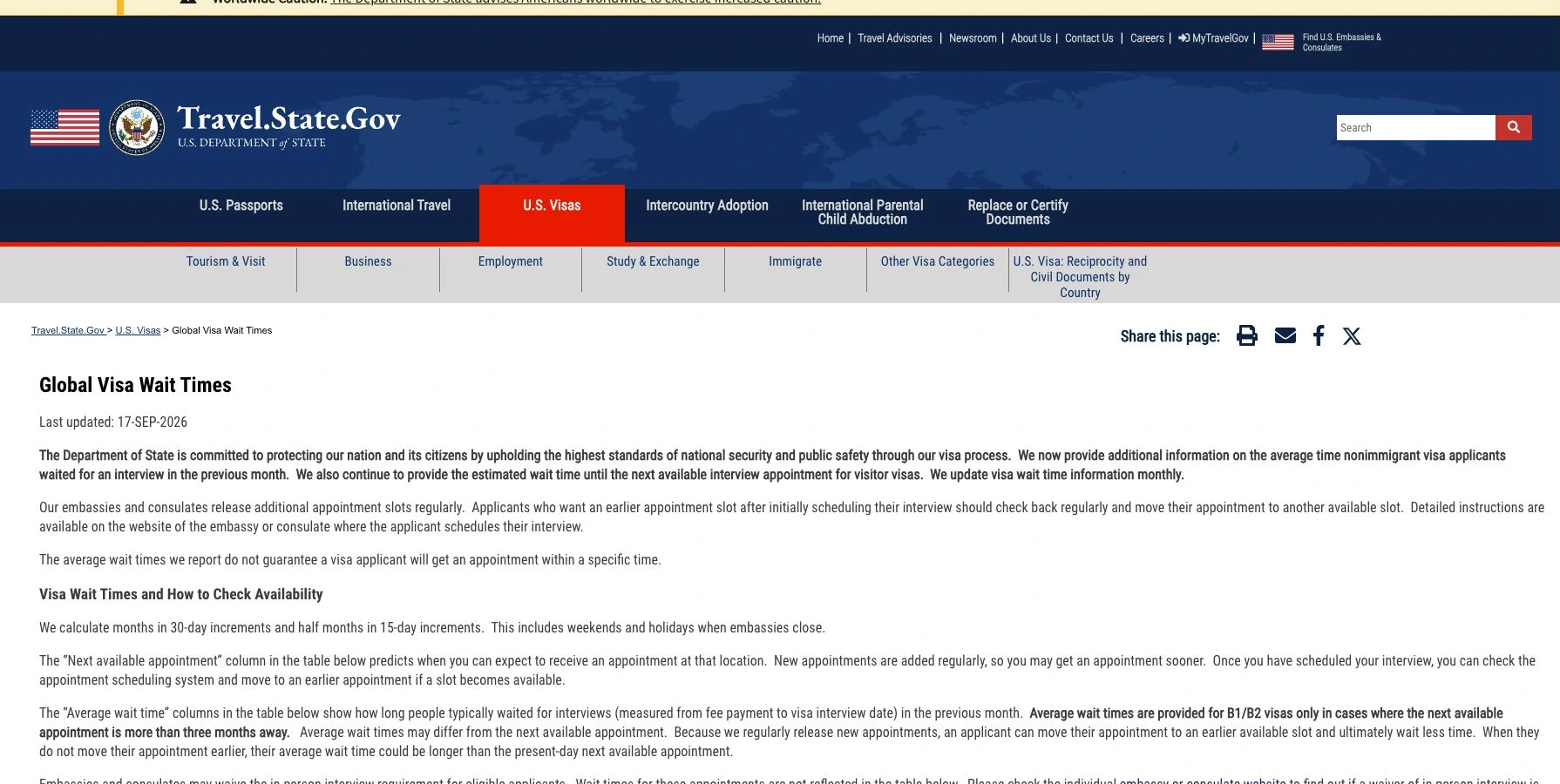
Source: U.S. Department of State, captured September 19, 2026. The official page dates its report and states that updates are monthly. Open the full-size image to inspect the source wording.
Average wait and next appointment are different measurements
The official explanation separates a backward-looking measure from an estimate of future availability. The average describes the previous month’s experience, measured from fee payment to interview. The next-appointment field estimates availability at that post; it is not a slot held for you.
| Field | The question it helps answer | What it cannot prove |
|---|---|---|
| B1/B2 average wait | How long did applicants typically wait in the previous month? | Your individual future wait. |
| B1/B2 next available appointment | What appointment wait does the report currently estimate? | A date you can definitely book now. |
| Another visa-category column | What estimate applies to that named category? | Availability for a different category. |
| Report update date | Which monthly snapshot am I reading? | When a particular appointment opened. |
The State Department says B1/B2 averages are provided where the next appointment is more than three months away. Do not convert NA or an absent number into zero days. An omitted measurement is not evidence of immediate availability.
Its month units also matter: a month represents 30 days and a half month 15 days, including weekends and holidays. Those are reporting units, not a promise about a particular calendar date.
A dated example: read Bogota without mixing the columns
We checked the Bogota row in the September 17 report. It showed 8.5 months for the B1/B2 average and 7 months for the B1/B2 next-appointment estimate. They differ by 1.5 reporting months, or 45 days using the source’s 30-day convention.
That subtraction illustrates the gap between two measures. It does not mean the same applicant saved 45 days, that appointments improved by 45 days since the last report, or that a new applicant will receive an interview exactly seven months later. Those conclusions would require different evidence.
For a comparison across reports, BAL’s August 26 summary preserves selected figures from the August 17, 2026 report. We compared three of its B1/B2 next-appointment figures with the September 17 official table:
| Post | August 17 estimate | September 17 estimate | Difference |
|---|---|---|---|
| Bogota | 9 months | 7 months | 2 months shorter |
| Beijing | 4 months | 4.5 months | 0.5 month longer |
| Mumbai (Bombay) | 14 months | 11.5 months | 2.5 months shorter |
The August figures come from BAL’s dated summary; September figures were checked directly on the government page. This small comparison shows why a global “waits are falling” headline is insufficient: these three posts did not all move in the same direction. It does not describe every post, explain the causes, or predict future appointments.
For a useful personal record, keep a small log with five fields: check date, report update date, post, category and column value. To compare monthly changes, compare the same field across successive reports. Do not compare last month’s average with this month’s next-appointment estimate and call the difference a trend.
A screenshot or copied table can become stale without looking wrong. Before acting on a shared image, open the official page and check both its date and headings. This article’s example is a September snapshot, not a continuously updated availability feed.
Why an earlier slot can appear between monthly reports
The State Department says posts release additional appointments regularly and directs applicants with an existing appointment to check the scheduling system for earlier openings, following local instructions. A monthly public report and a live appointment calendar therefore serve different purposes.
Avoid treating a long estimate as proof that no earlier opening can ever appear. Equally, a shorter estimate does not prove that your account can book that date. Interview-waiver appointment waits are outside this table, and the figures do not establish visa approval or issuance timing.
Manifest Law’s May 7, 2026 video explains the average-versus-next-appointment distinction using March 2026 data. It is an independent law firm’s explanation with attorney advertising, not a State Department video. Its historical country figures should not replace today’s official report or advice about an individual application.
Immigrant document processing is another timeline: our NVC processing-times guide covers that public queue. It should not be used as a nonimmigrant interview-availability estimate.
Follow the next public report with a narrow watch
If a calendar reminder is enough, use it. If you want to know when the public report changes, PageDog can check the visible update-date area on your Mac. Select the heading and Last updated line together. A concrete goal is: “Notify me when the Global Visa Wait Times update date advances beyond 17-SEP-2026.” Replace that baseline with the date you actually see during setup.
This is a prompt to revisit the report and read your own row. It does not monitor an appointment account, book a slot or determine visa eligibility. Selecting the stable date region also avoids depending on a temporary table filter that may behave differently when a page reloads in PageDog.
Inspect the saved baseline and run a manual check. Confirm that the report title and date are readable in PageDog’s own browser before scheduling. A verification challenge is not a usable report baseline; resolve access normally before relying on a watch. Use the PageDog documentation for setup and evidence review, and keep the region focused to reduce unrelated website alerts.
PageDog must be running with your Mac awake and online. Selected evidence is evaluated by hosted AI. Keep this watch on the public report; do not include passport details, application records or account messages. We have not tested this proposed setup against a future monthly publication, and an alert is not a guarantee of appointment availability.
Match the source to your next decision
Use the public table to understand a dated estimate. Use a consistent log to compare monthly reports. Use the official appointment system for booking decisions, and follow the relevant consulate’s instructions. When the report changes, check the post, category and column again before concluding that your own timeline has changed.