
In this article
Read the correct row before counting days
The State Department's NVC Timeframes page publishes a weekly update. The snapshot below records its September 14, 2026 update, checked September 16. It is a dated example; use the live source for later weeks.
| Queue | Date NVC reported working on |
|---|---|
| Case creation | Petitions received from USCIS on September 1, 2026 |
| Document review | Documents submitted on July 22, 2026 |
| Inquiry responses | Inquiries received on September 2, 2026 |
The reference date is different in each row. A petition's approval date, its receipt at NVC and a document submission date are not interchangeable. First identify the event your own notice records, then compare it with the relevant public row.
The page covers immediate-relative, employment-preference and family-preference cases. It expressly excludes diversity visas, special immigrant visas, K/fiancé(e) visas and adoption cases. Do not extend these figures to a category outside that scope.
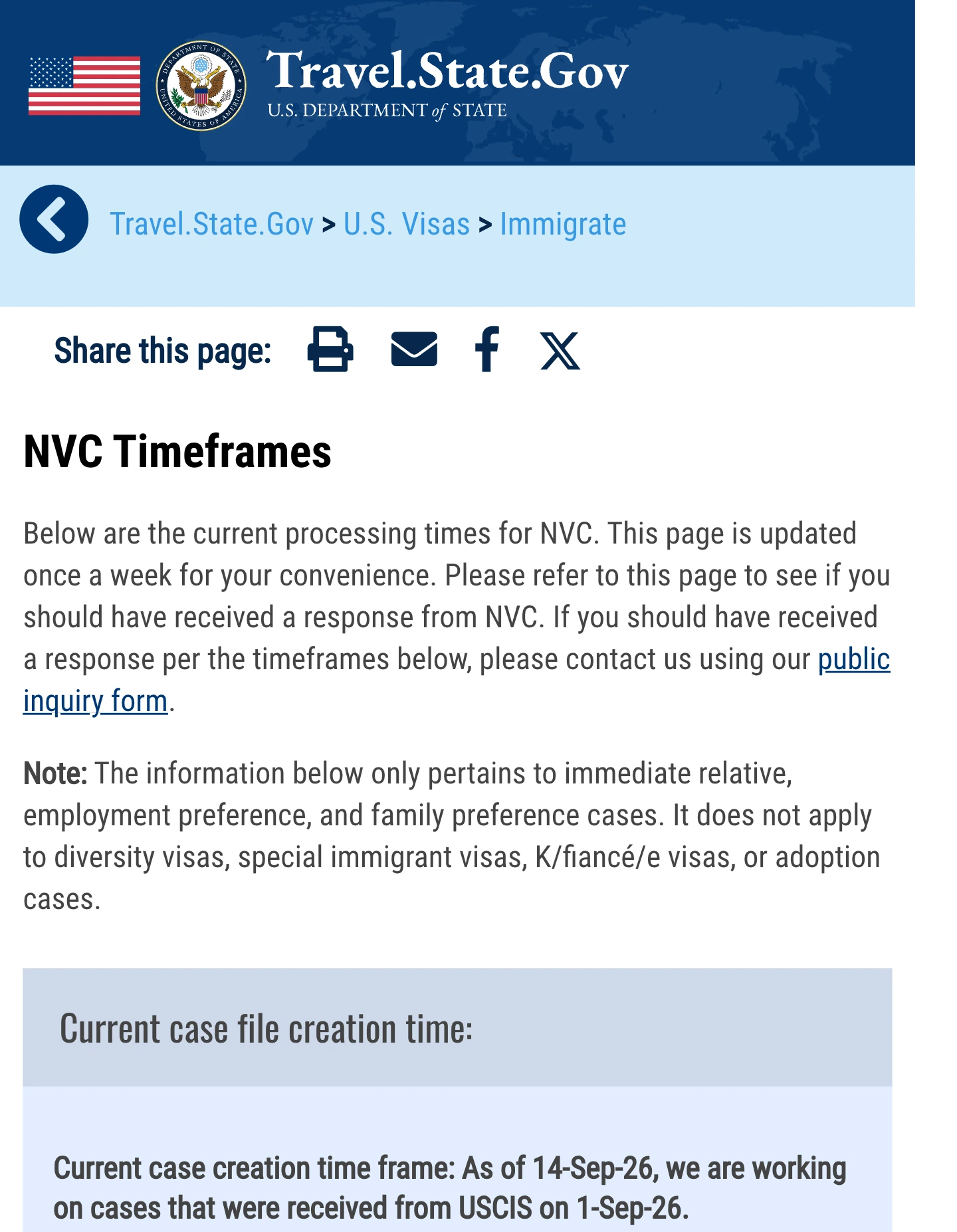
Source: U.S. Department of State, captured September 16, 2026. The visible creation row refers to cases received September 1; it is not an interview date.
Calculate the age of the snapshot, not a promised wait
Subtracting the reported receipt or submission date from the update date produces a useful comparison. For September 14:
- Case creation: September 14 minus September 1 = 13 calendar days.
- Document review: September 14 minus July 22 = 54 calendar days.
- Inquiry response: September 14 minus September 2 = 12 calendar days.
These are our arithmetic calculations from the published dates. They describe how far back each queue's reported working date sits at that snapshot. They are not average completion times, service guarantees or additional days that every applicant must wait.
For example, a document submission on July 25 is later than the July 22 date in this snapshot. That comparison alone cannot tell you that review will happen three days later. The queue can move by a different number of calendar days in each weekly update.
Use the same calculation method each time you save a new snapshot. Record the page's update date and all three working dates; do not silently substitute the day you opened the page. This article establishes one baseline and does not claim a measured historical trend.
Separate the public queue from your private case status
The official Begin NVC Processing guide explains the Welcome Letter and access to the Consular Electronic Application Center, or CEAC. That private account and official case messages serve a different purpose from a public processing-time page.
Use the public page to understand which submission dates NVC says it is working on. Use your own notices and CEAC to understand the information NVC has provided about your case. A changed public date is not evidence that your documents were accepted, that you are documentarily qualified or that an appointment has been booked.
Keep case numbers, invoice identifiers and uploaded documents out of public screenshots and general page monitors. You do not need any of those details to follow a change to the public timeframes page.
For a visual explanation, USImmigrationHelp's video published September 16, 2026 walks through the three September 14 dates. Its title refers to September 15. The relevant sections begin around 2:39 for case creation, 5:37 for document review and 7:26 for inquiries. It is an independent creator's explanation, not a State Department video; its broader visa discussion does not replace official category-specific instructions.
Use a separate source after documentary qualification
If your question is “When will my interview be scheduled?”, the three weekly dates are insufficient. Open the official Immigrant Visa Scheduling Status Tool, whose page was last updated September 9, 2026 when checked for this article.
That tool organizes information by interview location and immigrant-visa category. It uses the month and year a case became documentarily complete. Its figures still cannot guarantee a specific applicant's appointment date.
The distinction matters because “NVC processing time” is often used for several stages of a longer process. A document-review queue and a consulate's interview queue can change independently. Read the official interview preparation instructions when you receive an appointment notice, rather than treating a public queue estimate as that notice.
For additional context, CLINIC's explanation of NVC response times and consular backlogs separates these stages. Lozano Law Firm's I-130-to-NVC overview describes the broader sequence. Their dated estimates should be read alongside the current official pages, not substituted for them.
Follow one public update without repeatedly refreshing
Start with NVC's own case emails and CEAC for personal updates. Bookmark the weekly timeframes page for its public figures. If you want an alert specifically when one published queue date changes, PageDog can watch that visible text on your Mac:
- Open the official timeframes page and select the relevant queue's heading and dated statement.
- Set a goal such as “Tell me when the document-submission date being reviewed changes from July 22, 2026.” Use the actual current baseline when you set it up.
- Choose a daily check and confirm the saved evidence contains the whole date and queue label.
- After a matching alert, reopen the official page and save its new update date before drawing a conclusion.
See the PageDog documentation for selecting an area and reviewing evidence, and our explanation of visual website monitoring for the value of a bounded region. A public date watch does not need access to CEAC.
PageDog checks while it is running and your Mac is awake and online; hosted AI evaluates selected evidence against the goal. A watch cannot accelerate processing, predict a decision or submit an inquiry. If the source stops loading normally, resolve the watch's missing evidence before relying on it.
Decision rule: match the correct queue, retain its update date, and use official case channels for individual progress. The timeframes page directs readers to the NVC public inquiry form when a response is overdue under its published guidance; duplicate inquiries can slow responses. Case-specific legal questions belong with a qualified immigration professional.
Research sources
- Official: NVC Timeframes, Begin NVC Processing, the IV Scheduling Status Tool, interview preparation and NVC's inquiry channel.
- Independent context: the linked USImmigrationHelp walkthrough, CLINIC analysis and Lozano Law Firm overview.