In this article
Key facts
| Question | Current answer | Important caveat |
|---|---|---|
| Is Slack free? | Yes | Free keeps 90 days of message history and allows up to 10 app integrations. |
| How much is Slack Pro? | $8.75 monthly or $7.25/month billed annually | Slack bills active paid members and prorates member changes. |
| How much is Business+? | $18 monthly or $15/month billed annually | Advanced AI and administration—not message history alone—drive the upgrade. |
| Are invited people billed immediately? | No | Billing begins when an invitee accepts and signs in for the first time. |
| What happens when someone stops using Slack? | Slack marks them inactive after more than 28 days | The workspace receives a prorated account credit for unused time. |
These are standard public US prices checked on September 9, 2026, before tax. Slack currently advertises a temporary 50%-off first-three-months offer for some eligible new workspaces; the calculations below exclude it because eligibility and duration can change.
Slack plans and prices at a glance
The official Slack pricing page lists four plans. Annual billing saves $18 per Pro user and $36 per Business+ user over twelve months at standard rates.
| Plan | Monthly billing | Annual-billing equivalent | Annual total per user | Best fit |
|---|---|---|---|---|
| Free | $0 | $0 | $0 | Small or temporary teams that can live with 90-day history and 10 apps. |
| Pro | $8.75/user | $7.25/user | $87 | Teams needing unlimited history, integrations, group huddles, Slack Connect, and basic AI. |
| Business+ | $18/user | $15/user | $180 | Teams needing advanced AI, SAML SSO, SCIM, stronger administration, and 24/7 support. |
| Enterprise+ | Custom | Custom | Custom | Complex organizations requiring enterprise search, governance, security, and support. |
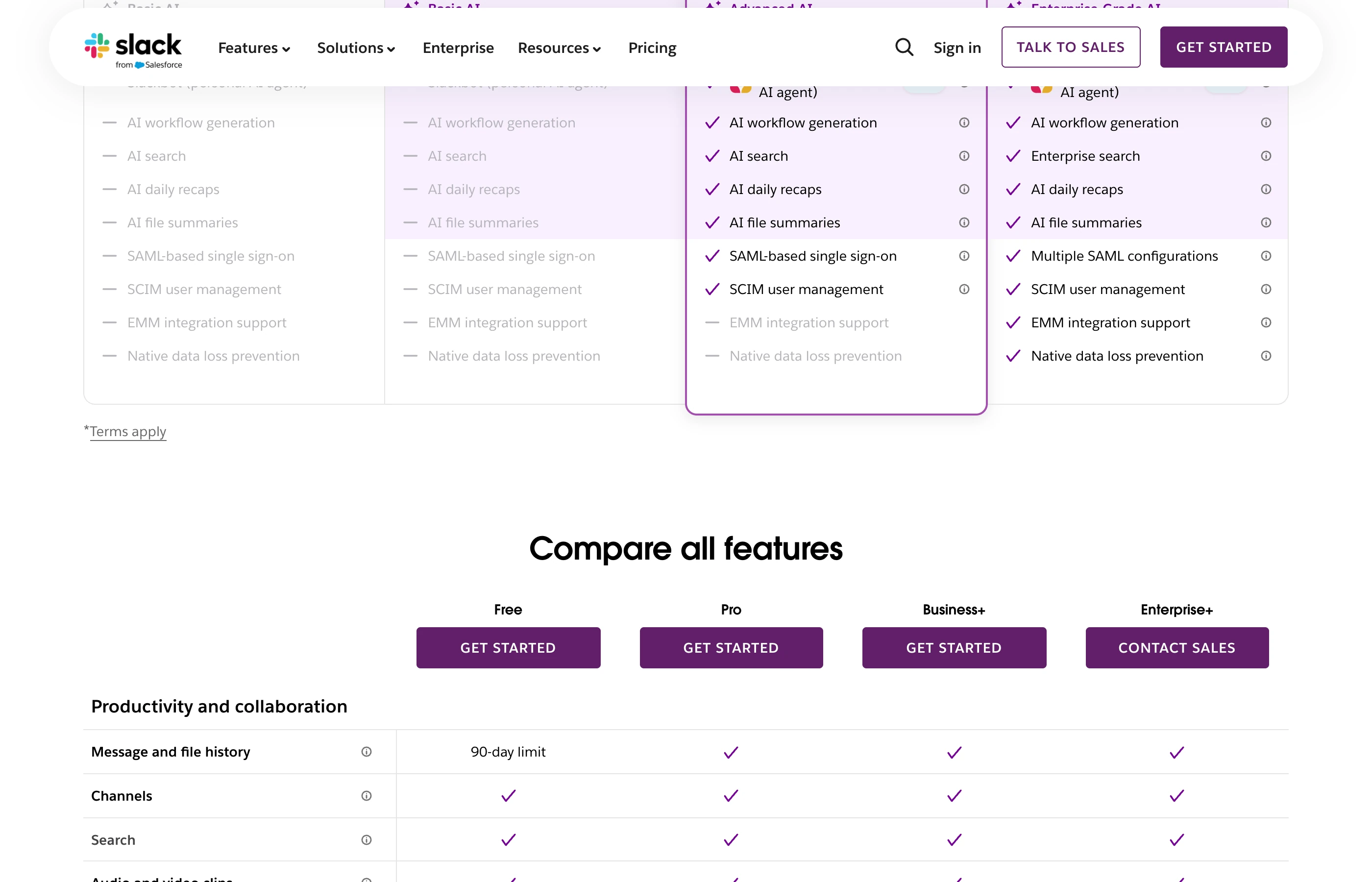
Screenshot: the official Slack pricing comparison showing the four current plan columns and product differences. Captured from the live branded page on 2026-09-09 at native DPR=2 resolution; the 2,800-pixel source is more than 3× its maximum article display width.
Free vs Pro vs Business+: what the price changes
Free is usable, not a timed trial. It limits searchable message and file history to 90 days, app integrations to 10, huddles to one-to-one meetings, and Slack Connect to one-to-one external messages.
Pro removes the history and integration limits, adds group huddles and group external collaboration, and includes basic AI features such as conversation summaries and huddle notes. It is the practical baseline when Slack is a system of record rather than a disposable chat stream.
Business+ adds advanced AI search, daily recaps, file summaries, workflow generation, SAML-based single sign-on, SCIM user management, and stronger support and administration. The annual rate is more than double Pro, so buy it for those workflows and controls—not because the team merely wants old messages.
Enterprise+ adds the broadest search, security, compliance, and organization controls. Its price is negotiated, so a public calculator cannot produce an honest total.
This Works Tutorials' May 6, 2026 video gives a two-minute visual tour of Free and paid-plan choice. It is useful orientation, but Slack's pricing and Help Center pages remain authoritative for exact prices, AI packaging, and Fair Billing.
Slack bills active members, not dormant accounts forever
Slack's Fair Billing Policy applies to subscriptions and add-ons purchased on Slack's website by credit card or self-serve invoice. It bills these paid member types when active:
- Workspace owners and admins
- Full members
- Multi-channel guests
Single-channel guests and bots are free. An invited member is not billed until the person accepts the invitation and signs in for the first time.
If a paid member has not used Slack for more than 28 days, Slack marks the account inactive and deposits a prorated credit for the unused part of the billing period. If the person returns, Slack charges the prorated amount for the remaining days. A deactivated member receives no workspace access and triggers the unused-time credit the next day.
If everyone becomes inactive, Slack still bills a minimum of one member unless the workspace downgrades to Free.
How Slack proration works
Slack uses days remaining in the billing period rather than charging a full new month immediately.
For the official Pro monthly example, a member added with 20 days left in a 30-day cycle costs:
($8.75 ÷ 30) × 20 = $5.83
If a Pro member is deactivated with 15 days left, the account credit is:
($8.75 ÷ 30) × 15 = $4.38
Monthly credit-card customers see new-member adjustments on the following monthly bill. Annual credit-card customers are charged the prorated remainder of the year at the end of the month; annual bank-transfer customers can receive a quarterly growth invoice.
Credits stay on the Slack account for future payments. They are not cash, are not transferable or refundable, and expire when the paid subscription ends.
Slack team-cost calculator
Stable-team totals at standard US prices are straightforward:
| Active paid members | Pro annual rate | Pro monthly rate | Business+ annual rate | Business+ monthly rate |
|---|---|---|---|---|
| 10 | $72.50/mo; $870/yr | $87.50/mo | $150/mo; $1,800/yr | $180/mo |
| 25 | $181.25/mo; $2,175/yr | $218.75/mo | $375/mo; $4,500/yr | $450/mo |
| 50 | $362.50/mo; $4,350/yr | $437.50/mo | $750/mo; $9,000/yr | $900/mo |
Do not multiply the rate by every historical account. Start with currently active paid members, exclude single-channel guests and bots, then estimate additions and departures. Fair Billing reduces waste automatically, but planned deactivation is more predictable than waiting 28 days for inactivity.
Which Slack plan is worth it?
Stay on Free when recent context is enough, integrations are limited, and one-to-one huddles cover the workflow. Upgrade to Pro when losing searchable history creates operational risk or the team needs unlimited integrations and group collaboration.
Upgrade to Business+ when advanced AI search and recaps, SAML SSO, SCIM, administrative control, or guaranteed support have a measurable value. For 25 people, the annual jump from Pro to Business+ is $2,325 per year; that is the amount those added capabilities must justify.
Ask Slack for Enterprise+ pricing when data governance, cross-organization search, large-scale administration, compliance, or procurement terms determine the decision. A public per-user number would be false precision.
How to catch a Slack pricing change
Use Slack's Manage Billing and Member Changes views for private invoices, active-member counts, credits, and renewal details. For a public change, PageDog can watch one visible region on the pricing or Fair Billing page—such as the Pro annual price, the Business+ AI row, or the 28-day inactivity rule—and notify you when that exact evidence changes. It cannot access a private workspace or alter billing.
For a broader monitoring setup, see the SaaS pricing changes guide, the website price-tracker guide, and the Asana pricing guide.
Frequently asked questions
Is Slack Pro $7.25 or $8.75 per user?
Both are current US rates. $7.25 per active user per month is billed annually; $8.75 is the month-to-month rate.
Does Slack charge for inactive users?
Not under its website Fair Billing policy. After more than 28 days without activity, Slack marks a paid member inactive and credits the unused portion of the billing period.
Are Slack guests free?
Single-channel guests are free. Multi-channel guests are billed like active full members.
Does Slack charge for pending invitations?
No. An invited person's account becomes billable after the invitation is accepted and the person signs in to the workspace for the first time.
Bottom line
Slack Pro costs $87 per active user per year on annual billing; Business+ costs $180. The real bill depends on active paid members, mid-cycle proration, and account credits, so reconcile Member Changes before multiplying a sticker price by headcount.
Research sources
- Slack pricing — current US plan prices, promotion, features, and plan comparison; checked 2026-09-09.
- Slack Pro plan — standard $7.25 annual and $8.75 monthly active-user prices; checked 2026-09-09.
- Slack Business+ plan — standard $15 annual and $18 monthly active-user prices; checked 2026-09-09.
- Slack's Fair Billing Policy — billable member types, proration, credits, and inactive-member rules; checked 2026-09-09.
- Invited members in Slack — when invited accounts become active and billable; checked 2026-09-09.
- Updates to Slack plan features and pricing — current AI packaging and Business+ price change; checked 2026-09-09.