
In this article
Key facts
| Question | Current answer | Important condition |
|---|---|---|
| Can hotel rates fall near check-in? | Yes | Empty-room risk can motivate a lower rate |
| Can the same hotel become more expensive? | Yes | Cheaper rate categories disappear as occupancy rises |
| Is a last-minute discount predictable? | No | Events, season, location, room type, and booking pace differ |
| What is the safer strategy? | Hold an acceptable refundable rate and keep comparing | Confirm the exact cancellation deadline before relying on it |
| Can a rate fall after booking? | Yes | Rebooking is safe only when both reservations' terms permit it |
Why hotel rates can move in either direction
A hotel room is perishable inventory: after the night passes, an unsold room cannot be sold later. Hotels use revenue management to balance expected occupancy and room rate. Booking pace, remaining room types, restrictions, competitor prices, local events, and cancellations can all affect the next visible offer.
That produces opposite outcomes:
- Low expected occupancy: the hotel or platform may release a promotion or cheaper rate.
- High expected occupancy: low-price rate categories disappear, prices rise, or the property sells out.
The direction is specific to the property and stay dates. A quiet business hotel on a Sunday can behave differently from the same hotel during a conference.
What current hotel-alert tools actually offer
KAYAK's May 13, 2026 guide says its hotel Price Alerts check prices daily and notify a signed-in user when prices move. A user can track one hotel or a destination and receive notifications by inbox or phone.
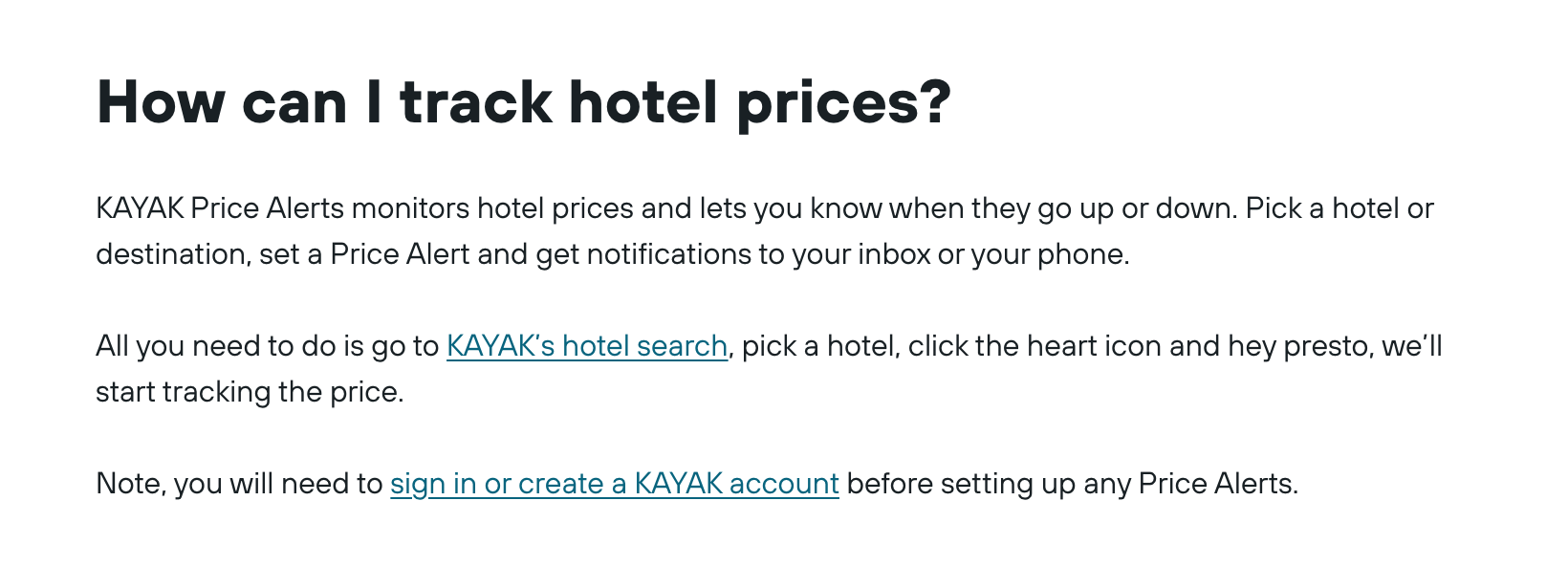
Screenshot: KAYAK shows how a signed-in user can track a hotel or destination and receive price-change notifications. Captured 2026-08-01.
KAYAK also recommends using its free cancellation filter when a traveler wants the option to cancel and rebook after a lower price appears. That advice is commercially motivated—KAYAK is a travel-search competitor—but the workflow exposes the important constraint: a lower future rate helps only if the original reservation can still be canceled without losing more than the saving.
A May 2026 academic article, Cancel, rebook, save, studies hotels' revenue loss when customers cancel and rebook after price cuts. The research confirms that the behavior exists and names services built around it. It does not prove that every traveler, property, or date will produce a saving.
See a hotel alert workflow in context
Video: App Ultra, published 2026-07-21. This recent third-party walkthrough is useful for locating Booking.com's alert flow. Booking.com can change the interface, and the video does not establish cancellation or refund terms, so verify those conditions on the actual offer before booking.
Compare the same hotel offer
A lower headline number may describe a different room or a stricter rate. Keep these details fixed:
| Detail | What must match |
|---|---|
| Stay | Same check-in and checkout dates |
| Guests | Same adults, children, and number of rooms |
| Room | Same bed, occupancy, view, and accessibility requirements |
| Cancellation | Same refund policy and deadline |
| Payment | Pay now versus pay at the property |
| Inclusions | Breakfast, parking, resort credit, or other benefits |
| Total | Taxes, property fees, and mandatory charges |
| Channel | Direct rate, member rate, or the same booking platform |
A nonrefundable room at €180 is not automatically better than a refundable room at €195. The option to change plans may be worth more than €15.
Dynamic search pages can also show a cheaper room for different dates after a search form resets. PageDog's guide to reducing false change alerts explains why the stay dates, room name, and terms must remain inside the evidence.
The refundable-backup strategy
Use this sequence when the trip is firm but the price is not:
- Book a room you would be willing to keep.
- Choose a refundable rate and record the exact cancellation deadline and hotel time zone.
- Save the room name, guest count, inclusions, and final total.
- Set native price alerts for the property or destination.
- If a genuinely equivalent lower rate appears, book the replacement first.
- Confirm the new reservation, then cancel the old one within its terms.
Booking the replacement first matters because price and inventory can change between opening the result and completing checkout. “Pay later” also does not automatically mean “cancel at any time.”
Waiting without a backup makes sense only when you can accept another property, neighborhood, or no trip at all.
Useful hotel tools and competing approaches
- KAYAK Hotel Price Alerts can track a named hotel or destination and says it checks daily.
- HotelTonight specializes in short-lead hotel inventory. Its own FAQ and price guarantee explain the terms; treat the bargain framing as a competitor's claim.
- HotelSlash is a service built around hotel price tracking and rebooking opportunities. Read its membership and booking terms before depending on it.
- Dataestur's hotel price dashboard provides current aggregate price-by-lead-time data for Spain; it is market context, not a prediction for one hotel.

Screenshot: HotelSlash says it monitors a reservation for price drops after booking. The surrounding savings language is HotelSlash's own commercial claim. Captured 2026-08-01.
Use the hotel's direct flexible rate and a mainstream travel alert before adding another paid service.
A practical decision rule
Choose a threshold large enough to justify changing the reservation:
Keep the refundable king room. Rebook only if the same room, breakfast, guest count, and cancellation terms appear for at least €40 less before 18:00 in the hotel's local time on the cancellation date.
Then:
- Book now if one property, room type, or accessibility feature matters.
- Wait with a refundable backup if the current rate is acceptable and rebooking is allowed.
- Wait without booking only if several properties are acceptable and losing this inventory is harmless.
Where PageDog fits
Use the hotel's own saved trip, KAYAK, Booking.com, or another native alert first. PageDog does not reserve, cancel, or rebook a room, and it cannot bypass sign-in or security checks.
It can watch a stable hotel-direct result that lacks the exact alert you need. Select the smallest complete visible area containing the hotel, dates, guest count, room, cancellation terms, and total. A useful goal is “Alert me when the refundable king room for October 12–15, two adults, is visible below €210 per night including mandatory fees.”
Checks run locally while PageDog is open and the Mac is awake. Review the PageDog documentation before relying on a date picker or signed-in search because sessions and form state can need manual attention.
Research sources
Primary and independent
- EHL Hospitality Business School: Hotel rate types — revenue-management and rate context.
- Tourism Management: Cancel, rebook, save — research article published 2026-05.
- Dataestur: Hotel prices by booking lead time — current Spanish market dashboard.
Competing travel tools
- KAYAK: How to track hotel prices — published 2026-05-13.
- HotelTonight FAQ and price guarantee — competitor terms.
- HotelSlash — hotel price-tracking and rebooking service.