
In this article
Key facts
| Question | Current answer | Data limitation |
|---|---|---|
| Is Tuesday reliably cheapest for buying? | No; Google's average difference was only 1.3% versus Sunday | U.S.-departing round trips observed from 2021 through 2025 |
| Can flying on a weekday be cheaper? | Yes; Monday through Wednesday averaged about 13% less than weekend departures | An average does not predict one route or date |
| Should you wait until next Tuesday? | Usually no | The current acceptable fare can disappear before then |
| What should you track? | The exact route, dates, cabin, bags, stops, and maximum total | A lower but materially worse itinerary is not the same offer |
What Google's current airfare data says
Google updated its travel analysis on September 9, 2025 using average round-trip fares observed from January 1, 2021 through August 1, 2025. It found that Tuesday had been the cheapest purchase day, but only 1.3% cheaper than Sunday, the most expensive purchase day.
The much larger distinction was the day of travel: flights departing Monday through Wednesday averaged about 13% cheaper than weekend departures. A layover averaged about 22% less than a nonstop flight in the same dataset.
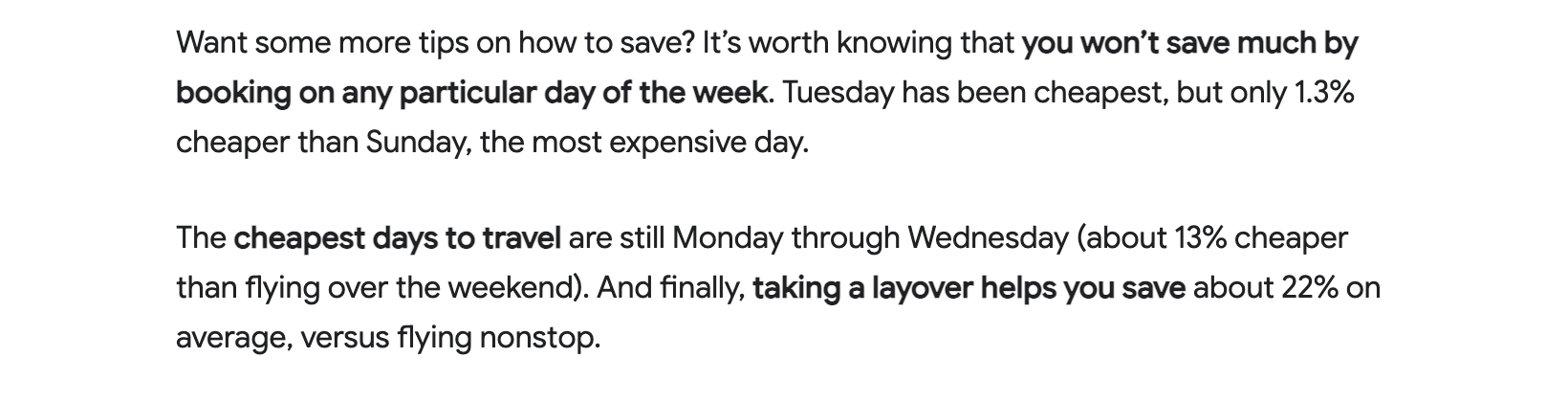
Screenshot: Google reports a 1.3% Tuesday-versus-Sunday buying difference and about 13% savings for Monday-through-Wednesday travel. Captured 2026-08-01.
The methodology matters. Google's results cover 4- to 16-day round trips departing from the top 4,000 U.S. markets. They are useful broad guidance, not a forecast for one Lisbon-to-Paris fare, one-way ticket, business-class seat, or holiday schedule.
Buying on Tuesday and flying on Tuesday are different
The old rule combines two questions:
| Question | Useful interpretation |
|---|---|
| Should I press Buy on Tuesday? | There is no dependable weekly advantage worth waiting for |
| Could a Tuesday departure cost less? | Yes; compare Monday-through-Wednesday travel dates |
| Will this exact fare fall again? | No dataset can promise that |
| Is the current result equivalent? | Only if route, dates, cabin, bags, stops, and restrictions still match |
Airfares can change whenever demand, inventory, fare classes, schedules, or airline decisions change. A drop observed on Tuesday does not mean Tuesday caused it.
If the trip is only weeks away and the current price meets the budget, waiting for the calendar can add risk without adding useful information.
Track the same itinerary, not the headline price
A cheaper result matters only when it remains acceptable. Hold these details constant:
- origin and destination airports;
- travel dates and passenger count;
- cabin and fare restrictions;
- maximum number of stops;
- acceptable departure and arrival times;
- checked and carry-on bag needs;
- total trip duration and airport changes;
- final price in the same currency.
A basic-economy fare without a bag is not a true drop from standard economy with one checked bag. A 6 a.m. one-stop route is not the same product as a nonstop evening flight.
For a visual watch, exclude unrelated result cards and dynamic recommendations. The PageDog guide to reducing false change alerts explains why a broad travel-results page creates noisy evidence.
Use native flight tools first
- Google Flights price tracking can watch selected dates, routes, or specific flights and email significant changes.
- KAYAK Price Alerts combines price alerts with its own forecast; the guide was updated May 11, 2026.
- Skyscanner Price Alerts describes email and app alerts for a selected route.
- Hopper's price predictions explain how another travel app estimates whether to book or wait.
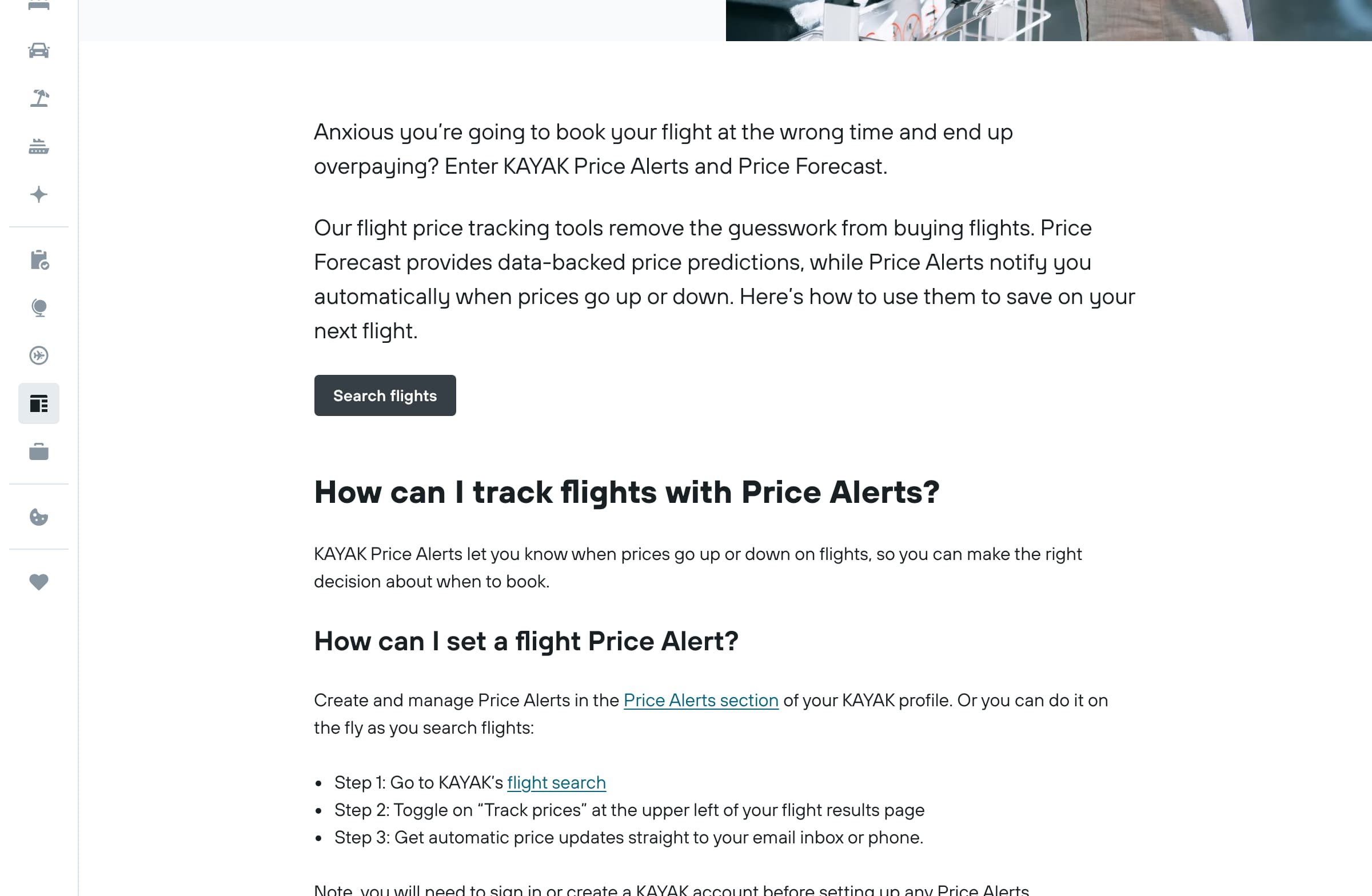
Screenshot: KAYAK shows that its Price Alerts report increases and decreases and can be enabled from a flight search before updates arrive by email or phone. Captured 2026-08-01.
See Google Flights tools in use
Video: ProgrammingKnowledge2, published 2025-12-03. The third-party walkthrough shows flexible dates, the price graph, Explore, and price tracking in one continuous flow. Use it to understand where the tools fit, then confirm the current controls in Google Flights before depending on a specific button or label.
These are commercial travel tools describing their own features. Their native understanding of dates, cabins, and inventory generally makes them a better first choice than a visual page monitor.
A better booking rule
Use this sequence:
- Define acceptable airports, dates, stops, times, cabin, bags, and total price.
- Compare nearby departure dates; this can matter more than purchase weekday.
- Turn on a native route alert.
- Set a maximum total that would make you book.
- Buy when an acceptable itinerary meets the threshold.
Do not optimize for the lowest price ever recorded. Optimize for a trip you would take at a price you accept.
Where PageDog fits
Use Google Flights, KAYAK, Skyscanner, or Hopper first for broad route tracking. PageDog does not know airline inventory, hold a fare, book a flight, or bypass a login or CAPTCHA.
It is reasonable only for a stable airline-direct result the native tools do not represent, such as a member fare or one visible schedule. Select the smallest complete evidence area containing the flight, fare name, bag rule, and price.
For example: “Alert me when the nonstop 08:10 flight on September 14 is visible in standard economy for €220 or less, including one checked bag.” The PageDog documentation explains when scheduled checks run locally and when a saved page session needs attention.
Research sources
Official and primary
- Google: 2025 holiday travel trends and booking data — published 2025-09-09; includes methodology and current buying-day analysis.
- Google Travel Help: Track flights and prices — current native alert workflow.
Competing travel tools
- KAYAK: Flight Price Alerts and Price Forecast — updated 2026-05-11.
- Skyscanner: Price Alerts — updated 2025-12.
- Hopper: About price predictions — methodology overview from Hopper.