
In this article
Key facts
| Question | Current answer | Important caveat |
|---|---|---|
| Do resale prices fall near showtime? | Sometimes | The effect depends on demand, remaining inventory, and the seats you will accept |
| Is there a guaranteed cheapest hour? | No | A marketplace-wide average cannot predict one artist, city, date, or section |
| Are primary tickets the same market? | No | Organizers control primary inventory; individual sellers price resale inventory |
| Is the lowest displayed price comparable? | Often no | Keep section, quantity, view, restrictions, and mandatory fees constant |
| Who should consider waiting? | Flexible local buyers | Waiting is riskier when travel, accessibility, or adjacent seats matter |
What current resale guidance says
StubHub's June 10, 2026 guide says last-minute prices can fall when sellers prefer a reduced return to an unused ticket. It also says the pattern splits near showtime: softer-demand events can see meaningful drops, while high-demand events may hold or climb.
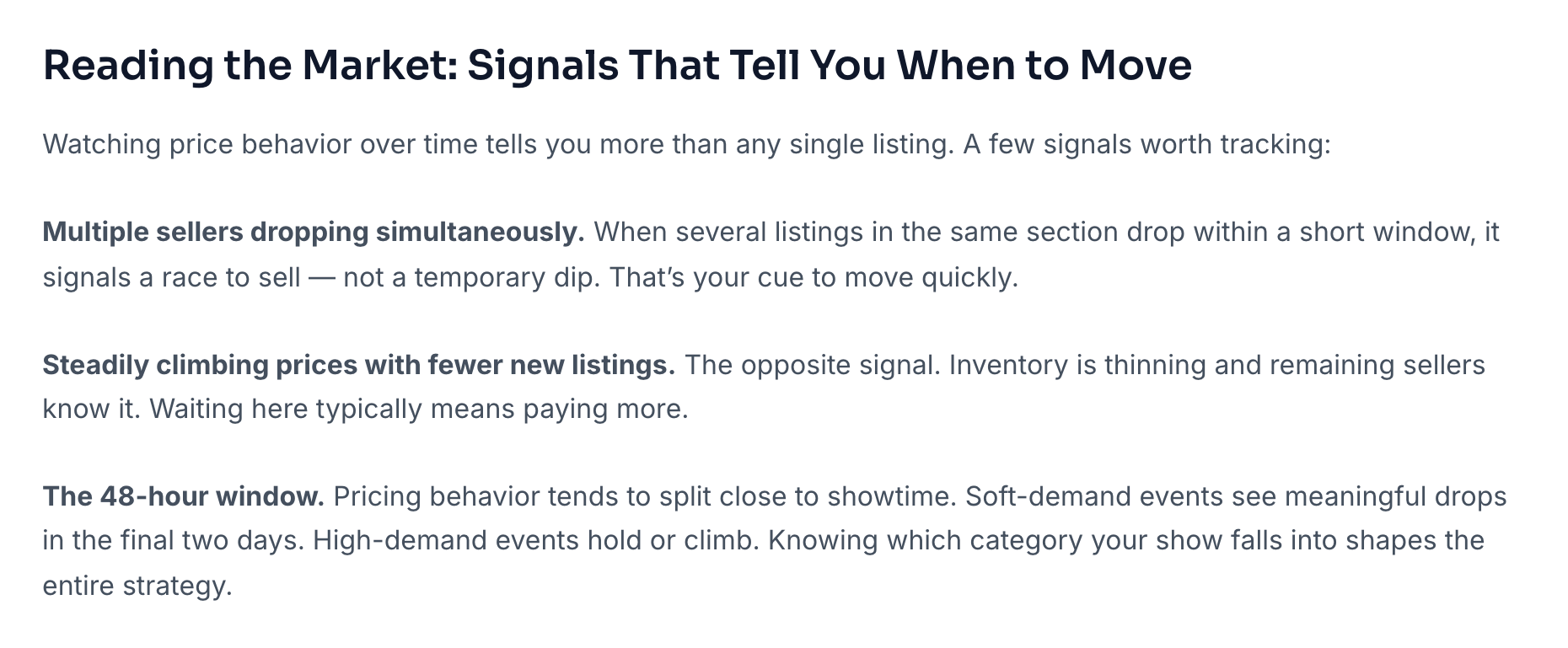
Screenshot: StubHub identifies simultaneous seller cuts, thinning inventory, and the final 48 hours as signals to interpret rather than a guaranteed discount. Captured 2026-08-01.
That is marketplace guidance, not neutral market research, but the decision model is useful: watch both price and inventory. A falling price with many comparable listings means something different from one cheap ticket surrounded by increasingly scarce seats.
Older evidence points in the same conditional direction. A U.S. Government Accountability Office review documented that secondary-market prices can move both above and below face value. Academic work has found price declines as some events approach, but neither source supports a universal “buy at 3 p.m. on show day” rule.
Separate primary, resale, and demand-priced tickets
Three ticket types can appear on one seat map:
| Ticket type | Who controls the current price? | Why it can change |
|---|---|---|
| Primary standard ticket | Event organizer | Inventory releases, production holds, or organizer decisions |
| Official Platinum or other demand-priced primary ticket | Event organizer under demand pricing | Current demand for the event and location |
| Fan or broker resale ticket | Reseller | Seller urgency, competing listings, and buyer demand |
A late primary release is possible after stage and production plans are finalized, but it is not promised. A resale seller may cut a listing as the deadline approaches. A scarce resale seat for a sold-out show may become more expensive instead.
Read the label before comparing prices. “Official Platinum” is not the same as fan resale, even when both prices move.
A November 2025 example shows why tour-specific rules matter.
See the public resale-policy exchange
Post: Pop Crave on X, published 2025-11-21. This post preserves Olivia Dean's response to inflated resale listings after the original Instagram Story expired. It is an attributed archive, not a permanent Instagram source.
Post: Ticketmaster on X, published 2025-11-22. Ticketmaster said it would cap resale on that tour at face value. That was a specific intervention, not a general rule for concert prices.
Signals that make a late drop more or less likely
A last-minute discount is more plausible when:
- many equivalent resale seats remain;
- several sellers cut similar listings close together;
- the artist has multiple local dates;
- the show is not sold out;
- you can accept different sections or a single seat;
- you can skip the event if no bargain appears.
Waiting is riskier when:
- the show is sold out with few listings;
- remaining prices are climbing as inventory thins;
- you need two or more adjacent seats;
- you need an accessible seat or a particular view;
- the city has one date;
- travel, a hotel, or childcare is already committed.
The final 48 hours are not magic. They are simply when seller urgency and buyer scarcity become harder to ignore.
Compare the all-in price for the same seat need
In April 2026, the U.S. Federal Trade Commission announced a StubHub settlement over allegedly deceptive ticket-pricing practices and refunds tied to fees. Whatever marketplace you use, compare the final amount rather than the first large number on a listing.
Keep these variables fixed:
- event city, date, and start time;
- section, row, and approximate view;
- number of adjacent seats;
- ticket type and restrictions;
- mandatory fees and taxes visible before purchase.
If two seats together are required, the lowest single-seat offer is not your price. If a cheaper section has an obstructed view, it is not the same product.
For noisy seat maps, PageDog's guide to reducing false website-change alerts explains why the evidence should exclude ads, recommendations, clocks, and unrelated inventory.
Useful ticket tools and competing viewpoints
- StubHub's last-minute buying guide gives a marketplace's current signal-based approach.
- Gametime's explanation of last-minute inventory describes why its product emphasizes late tickets; treat this as a competitor explaining its own model.
- TickPick's day-of-event price analysis is sports-focused but useful for seeing how another no-buyer-fee marketplace frames the timing question.
- The FTC's 2026 StubHub settlement announcement is the independent reminder to compare required fees and actual checkout totals.
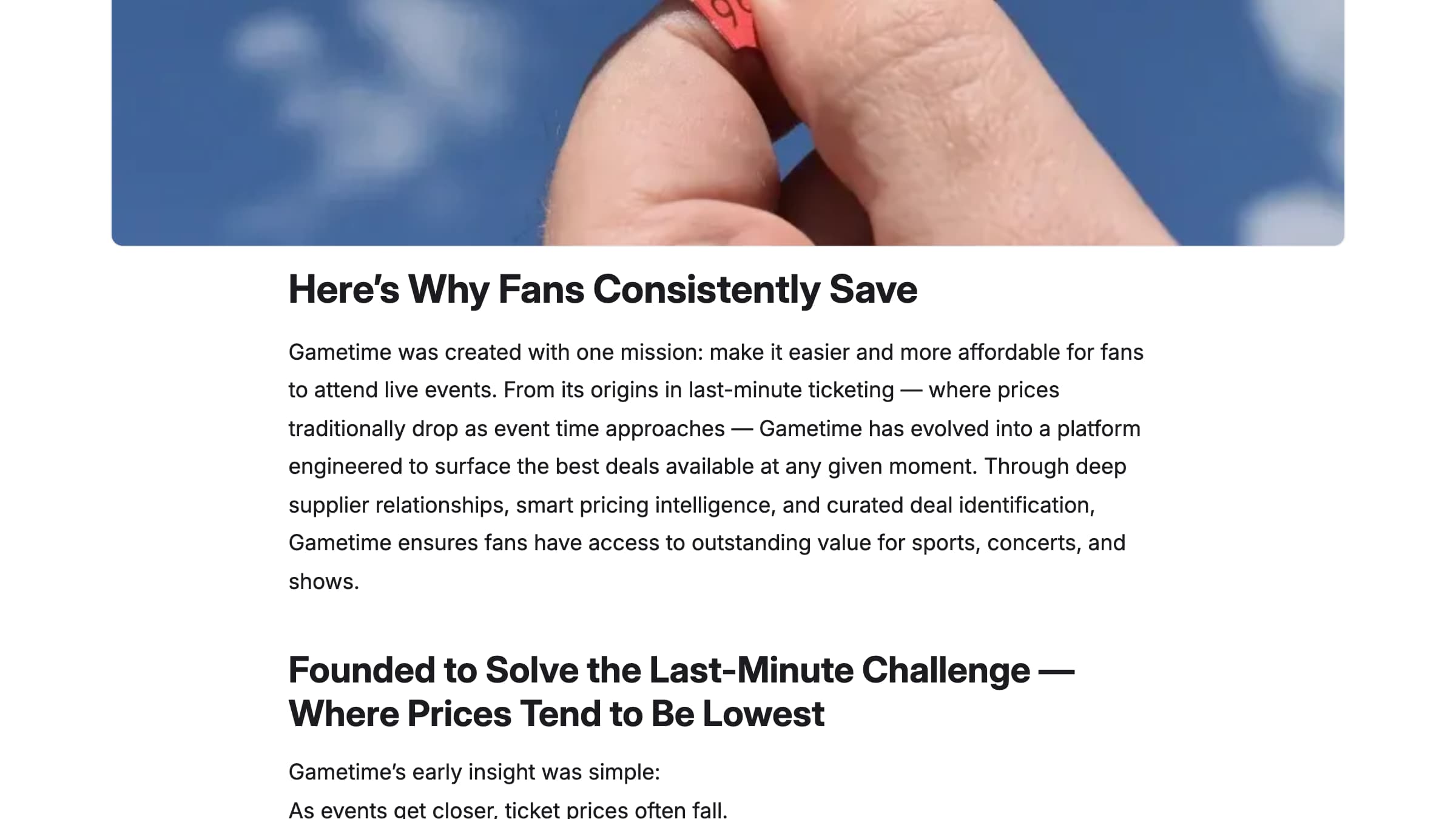
Screenshot: Gametime says ticket prices often fall as an event approaches and presents that pattern as part of its own marketplace model. Captured 2026-08-01.
This is a useful competitor viewpoint, not neutral proof that a specific concert will become cheaper. The inventory and all-in price for the actual event still decide whether waiting worked.
A practical wait-or-buy rule
Write down four limits before watching:
- Acceptable sections and views.
- Required number of adjacent seats.
- Maximum all-in price per ticket.
- Latest safe purchase time.
Then apply this rule:
- Buy now when attendance matters more than a modest saving, current seats meet the limits, and inventory is thinning.
- Wait when many equivalent listings remain, you are local and flexible, and missing the event is acceptable.
- Stop waiting at the deadline you chose, even if the theoretical lowest price has not appeared.
This turns an open-ended prediction into a decision you can execute.
Where PageDog fits
Use native marketplace alerts first when they can watch the event or section you need. PageDog cannot predict the market, guarantee a ticket, purchase a seat, or bypass a queue or CAPTCHA.
It can watch one stable visible condition that a native alert misses. Select the smallest area that proves the result, such as two adjacent verified resale tickets in sections 101–105 with an all-in price below €140 each. Including the quantity, section, resale label, and price makes the evidence reviewable.
Checks run locally while PageDog is open and the Mac is awake. If that timing is suitable, download PageDog for Mac and test the watch before the event becomes urgent.
Research sources
Official, regulatory, and original research
- Ticketmaster: How ticket prices and fees are determined — primary versus resale pricing.
- U.S. GAO: Event Ticket Sales — secondary-market practices and consumer issues, 2018.
- NBER: Secondary Market for Tickets — older market study; useful for historical behavior, not a current-price forecast.
- FTC: StubHub refund settlement — published 2026-04.
Marketplaces and competing tools
- StubHub: Last-Minute Ticket Buying — published 2026-06-10.
- Gametime: Why last-minute inventory can produce deals — published 2025-12-10.
- TickPick: Do prices drop the day of the event? — marketplace analysis.