In this article
Key facts
| 2026 question | Verified answer |
|---|---|
| Did Amazon announce a new blanket shopper return window? | No. Amazon still says most items can be returned within 30 days of the estimated delivery date, with category and item-specific exceptions. |
| What changed for US sellers? | From February 8, Amazon Prepaid Return Labels became required for eligible seller-fulfilled returns regardless of item value; the former high-value exemption ended. |
| What changed for shoppers? | On March 25, more than 1,500 FedEx Office locations joined Amazon's eligible no-box, no-label return network. |
| Is every return free and box-free? | No. Eligibility and available methods appear in the return flow for the exact order. Some UPS Store returns can show a fee when a closer free option exists. |
| Is the 2025 holiday extension still active? | No. It ended January 31, 2026 for most eligible holiday purchases and January 15 for Apple-branded products. |
These are US rules and announcements checked on August 22, 2026. Your Orders is the authority for an individual purchase because the item, seller, category, condition, location, and return reason can change the available window and method.
The headline mixes two different audiences
Search results for “Amazon return policy update” combine shopper articles, seller announcements, expired holiday rules, and older fee changes. That makes a dramatic headline easy to misread.
The useful split is:
- Shopper policy: whether an item is returnable, until when, and by which method.
- Seller-fulfilled operations: who creates the label and how Amazon handles the return workflow.
- Seasonal exceptions: temporary windows tied to a purchase period.
- Return-network updates: where an eligible item can be dropped off.
Only the first category can answer “Can I return my order?” The others may change the process without changing the item's underlying return deadline.
What changed for sellers on February 8, 2026
Amazon's official Seller Forums announcement says all US sellers must use the Amazon Prepaid Return Label program for eligible customer returns regardless of item value from February 8, 2026. The previous high-value exemption was removed.
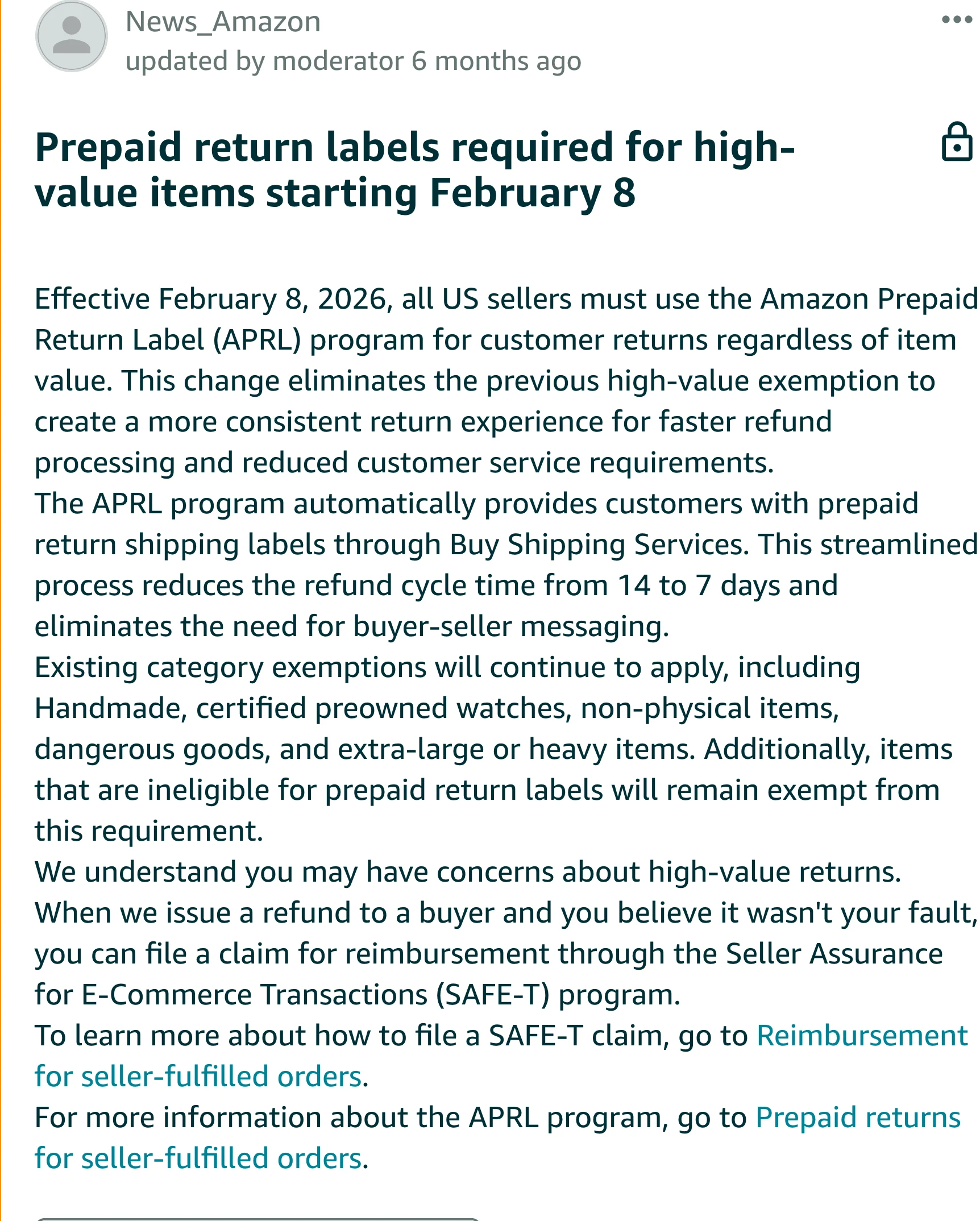
Screenshot: the official Amazon seller announcement states that the APRL requirement now applies regardless of item value. Captured 2026-08-22 at native 4× device scale and cropped without alteration.
The announcement describes three operational effects:
- Amazon supplies prepaid return shipping labels through Buy Shipping Services.
- Amazon says the refund cycle falls from 14 to 7 days.
- Buyer-seller messaging is no longer needed for that label workflow.
The scope matters. Amazon later clarified the requirement is for US seller-fulfilled orders. Existing exemptions continue for categories such as Handmade, certified preowned watches, non-physical items, dangerous goods, and extra-large or heavy items; products ineligible for prepaid labels also remain exempt.
This is a material seller policy update, but it is not proof that every shopper received a new return window. Amazon's own guide to seller-fulfilled customer returns still describes the general shopper rule as most items returnable within 30 days of the estimated delivery date, regardless of who fulfilled the order.
CNBC's June 22, 2025 report shows the cost, fraud, and resale pressures sellers can face when handling Amazon returns. It is useful operational context, not evidence for the February 2026 APRL rule itself; the official Amazon announcement above remains the source for the rule's date and scope.
Video: CNBC, published 2025-06-22. Useful for understanding the seller-side economics behind return-policy changes; the limitation is that it predates and does not document Amazon's 2026 APRL requirement.
What changed for shoppers on March 25, 2026
Amazon added more than 1,500 FedEx Office locations to its US return network. For eligible returns, shoppers can choose a participating location in the account return flow, receive a QR code, and bring the unpackaged item without printing a label.
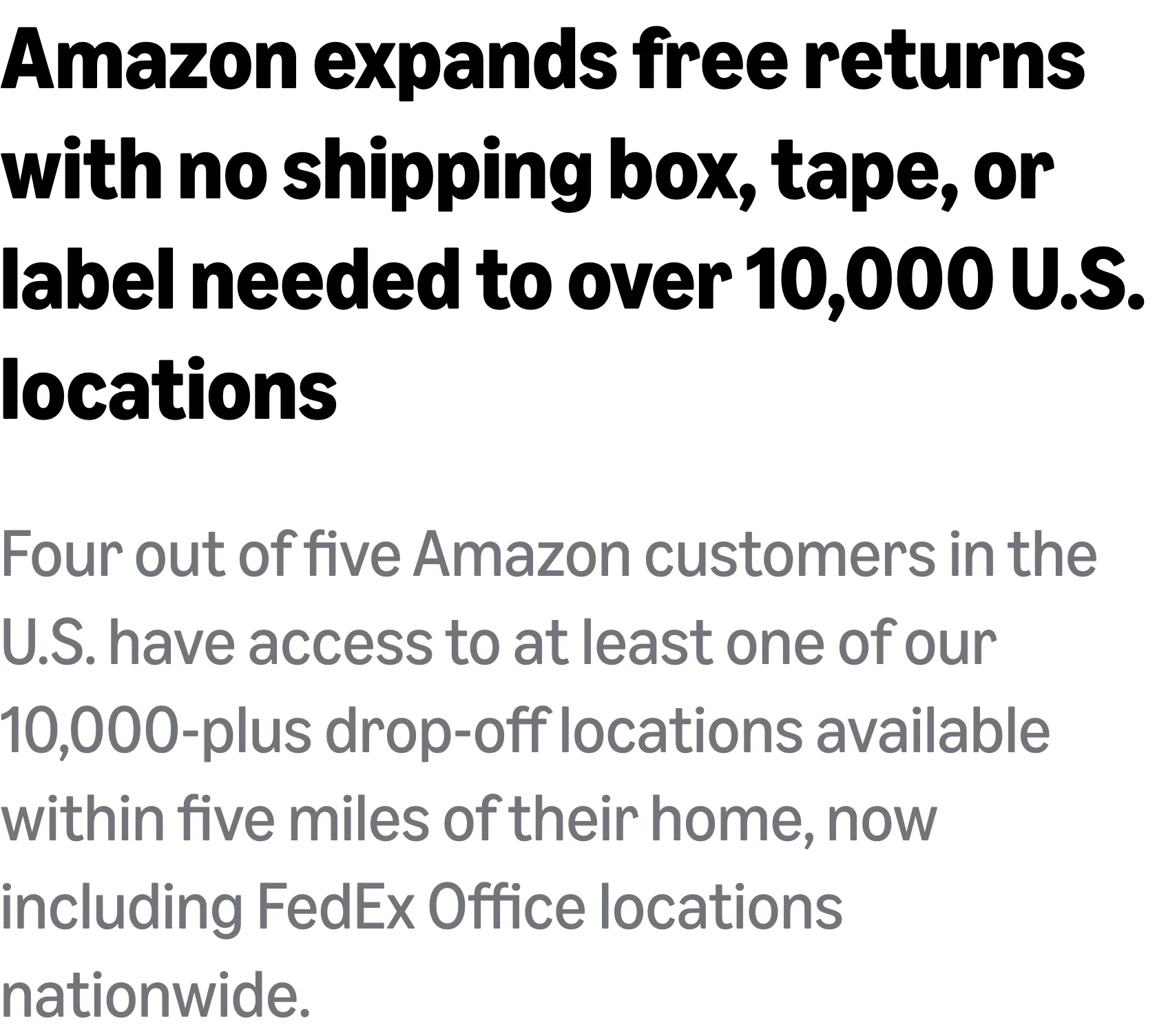
Screenshot: Amazon's official return-network announcement shows the FedEx Office expansion and the 10,000-plus US location claim. Captured 2026-08-22 at native 4× device scale and cropped without alteration.
The network now exceeds 10,000 US drop-off points and includes FedEx Office, Whole Foods Market, The UPS Store, Kohl's, Staples, and regional partners. Independent Axios coverage confirmed that the expansion was limited to FedEx Office locations, not every FedEx drop-off point such as Walgreens.
This update changes convenience, not universal eligibility. Amazon says the exact options are shown in the Returns Center. Its announcement also notes that some UPS Store returns may carry a $1 fee if another free option is closer to the delivery address.
What did not become permanent in 2026
Amazon's extended 2025 holiday window is a common source of stale advice. The official holiday policy covered most items purchased from November 1 through December 31, 2025, allowing returns through January 31, 2026. Apple-branded products had a January 15 deadline.
Both dates have passed. They should not be presented as the current everyday return window, and the seasonal article does not establish the policy for a purchase made later in 2026.
The safest current generalization is narrower: Amazon allows returns for most items within 30 days of the estimated delivery date, but exceptions exist. A product page's return badge and the order-specific return flow carry more weight than a generic roundup.
How to verify your exact Amazon return
Use the account flow before making a trip or assuming a deadline:
- Open Your Orders and select the exact item.
- Choose Return or Replace Items if the option is available.
- Read the displayed deadline, reason requirements, refund method, and any fee.
- Select only a drop-off location offered for that return.
- Check whether Amazon says to bring packaging, a printed label, or only a QR code.
A nearby FedEx Office may participate in the program but still not appear for a particular item. Likewise, a “FREE Returns” badge is evidence for that listing, not every product sold on Amazon. Amazon's current overview of how the returns process works explicitly tells shoppers to look for the badge and says free returns apply to most eligible US items.
Refund timing also depends on the stage and payment method. Amazon says the vast majority of eligible refunds are issued within five hours after drop-off, while the time for money to reach a card or bank account can take longer. Do not turn that operational target into a guarantee for every return.
When monitoring the policy is useful
Use Amazon's own account and native notices first. If you need to follow a public policy for future orders or seller operations, monitor the smallest stable block that owns the condition: the 30-day general rule, a named category exception, the APRL effective-date paragraph, or the list of eligible return partners.
PageDog can check one selected visible region locally on your Mac while the app is running and the computer is awake and online. It cannot see the return options inside a different person's account, predict whether Amazon will approve a return, initiate the return, or bypass a sign-in. Keep the watch focused; the guide to reducing false website-change alerts explains why a whole Amazon page is likely to produce noise.
For a dated policy record, combine the visible wording with the website last-updated checklist. If the decision is time-sensitive, reopen Amazon directly rather than relying on an old screenshot or notification. The same source-first principle applies to Amazon price changes; see whether Amazon notifies shoppers about price drops.
Frequently asked questions
Did Amazon change its return policy to 14 days in 2026?
The verified US sources reviewed here do not announce a blanket 14-day shopper window. Amazon's seller guide still says most items can be returned within 30 days of the estimated delivery date, with item and category exceptions. Check Your Orders for the exact purchase.
Are Amazon returns now free at every FedEx location?
No. Amazon announced eligible free, no-box returns at participating FedEx Office locations. Axios reported that the expansion did not include other FedEx drop-off points such as Walgreens. The location must appear in the return flow for your item.
What is APRL?
APRL is Amazon Prepaid Return Label. For eligible US seller-fulfilled returns, Amazon creates the prepaid label through Buy Shipping Services. The February 2026 change removed the previous exemption based only on high item value.
Can high-value Amazon items still be exempt from prepaid labels?
High value alone is no longer the exemption described in Amazon's February announcement. Category and label-eligibility exemptions still apply, including certain Handmade, dangerous, non-physical, extra-large, and heavy items.
How long does an Amazon refund take?
It varies. Amazon says most eligible refunds are issued quickly after drop-off, but the return may require inspection and the payment method affects when funds arrive. Use the timeline shown for the exact return rather than a universal estimate.
Bottom line
The 2026 Amazon return-policy story is not one blanket shopper deadline. The major rule change is APRL coverage for eligible US seller-fulfilled returns regardless of value; the shopper-facing change is a larger eligible no-box drop-off network. Verify every order in Your Orders before acting.
Research sources
- Amazon seller announcement: prepaid labels for high-value items — February 8 APRL requirement, scope, cycle-time claim, and exemptions; checked 2026-08-22.
- How to manage seller-fulfilled customer returns — Amazon's general 30-day explanation and seller-fulfilled process; checked 2026-08-22.
- Amazon expands free returns to more than 10,000 locations — FedEx Office expansion, eligibility, partners, and fee caveat; checked 2026-08-22.
- Amazon holiday return policy 2025 — expired January 2026 seasonal deadlines; checked 2026-08-22.
- How the Amazon returns process works — current overview of eligible free returns, drop-off locations, and refund handling; checked 2026-08-22.